AllesAll, was ein Gelände bewohnbar macht, bevor irgendein Kanal in der Nähe liegt."> AllesAll, was ein Gelände bewohnbar macht, bevor irgendein Kanal in der Nähe liegt.">
Was ihr bauen könntWhat you can build

Wasser und KloWater and toilets

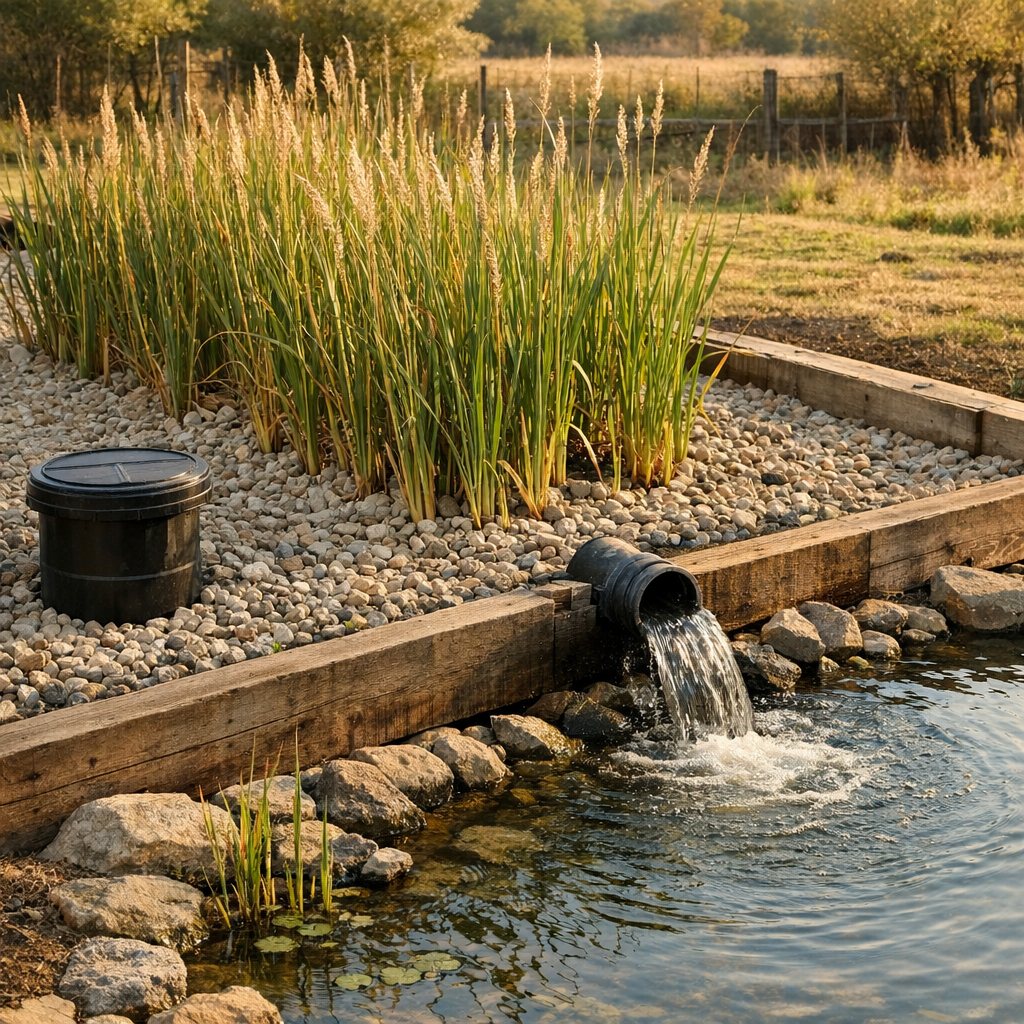
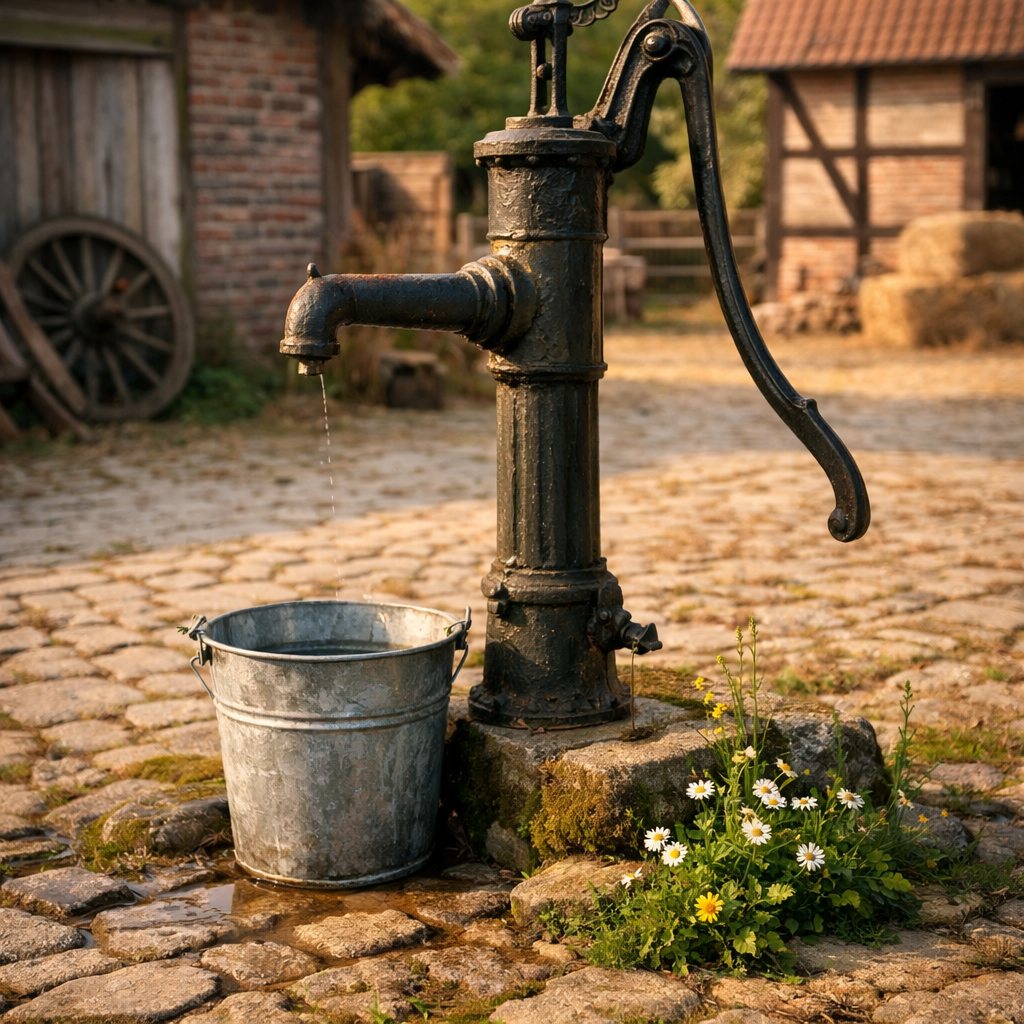
Trockentrenntoilette, Draußendusche, Regenwasser, Pflanzenkläranlage. AllesAll, was ein Gelände bewohnbar macht, bevor irgendein Kanal in der Nähe liegt.

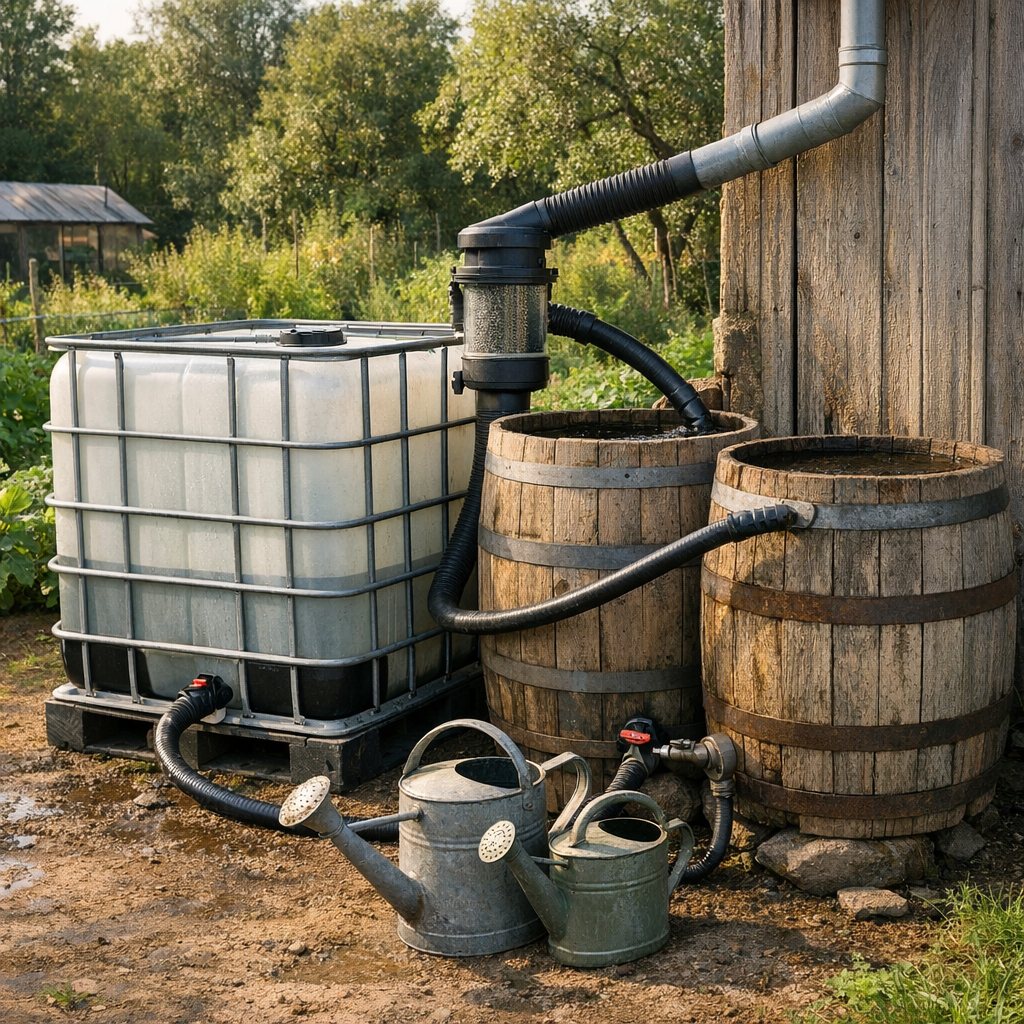
Regentonnen und eine Zisterne an einer Scheunenwand, daneben eine alte Schwengelpumpe und ein bepflanztes Klärbeet, Morgenlicht
Schon heute realAlready real today

Das Ökodorf Sieben Linden in der Altmark verzichtet seit der Gründung vollständig auf Wasserspülung. Rund 70 Trockentrenntoiletten, dazu eine offiziell genehmigte Kompostieranlage, in der die Fäkalien in einem dreijährigen Prozess zu Erde für Baum- und Strauchpflanzungen werden. Der Trinkwasserverbrauch liegt bei 60 bis 70 Litern pro Person und Tag, etwa der Hälfte des Bundesdurchschnitts von 125 Litern.

AufwandEffort
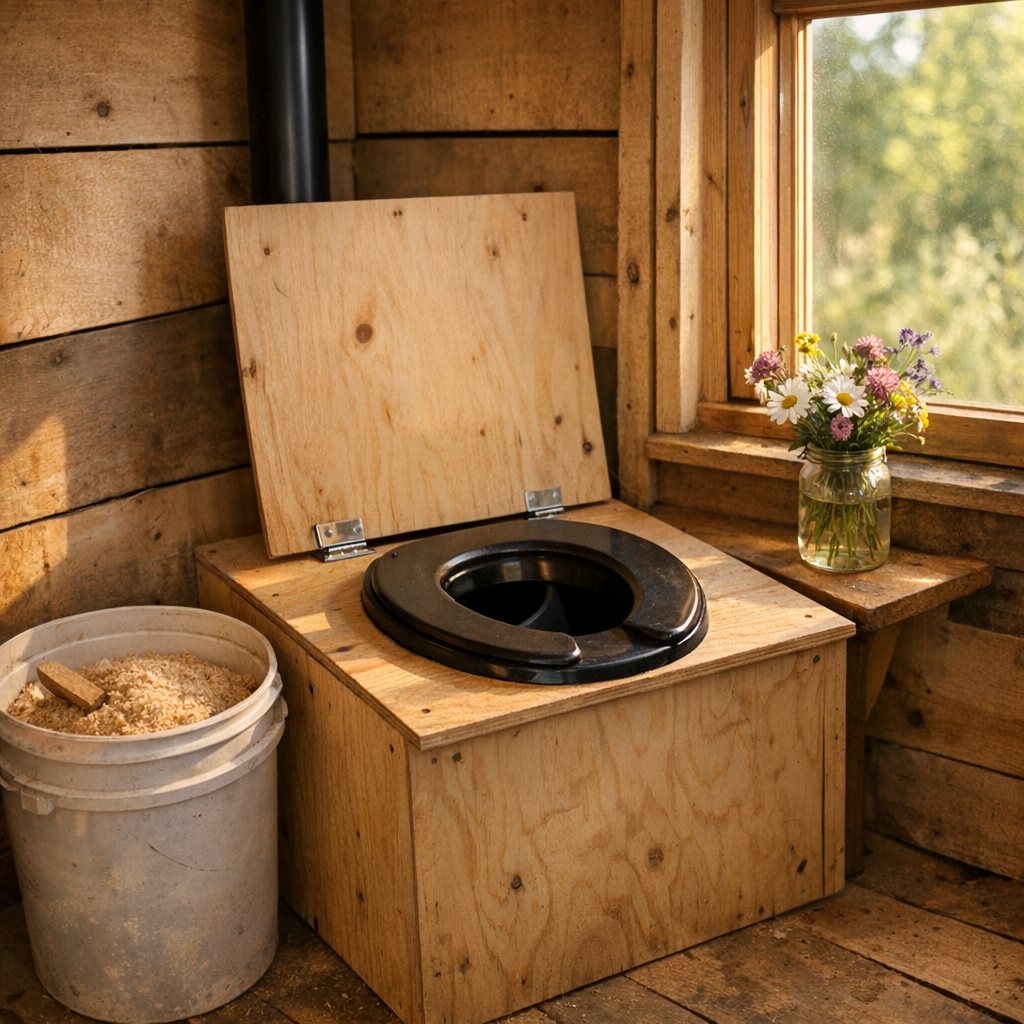
Trockentrenntoilette, Dry separating toilet
Ein WochenendeOne weekendEtwas ÜbungSome practice helps

TrockentrenntoiletteDry separating toilet

2 Personen2 people

Der Klassiker jeder jungen Gemeinschaft. Urin und Feststoffe werden getrennt aufgefangen, es fließt kein Tropfen Spülwasser, und ihr braucht keinen Kanalanschluss. Eine vierköpfige Runde spart damit rund 15.000 Liter Trinkwasser im Jahr.The classic first build in any young community. Urine and solids are caught separately, not a drop of flush water is used, and you need no connection to the sewer. A group of four saves around 15,000 litres of drinking water a year.

So wird gebautHow it is built
Sitzkiste aus Siebdruckplatte, Trenneinsatz, zwei Eimer, Streu aus Sägespänen oder Rindenmulch. Dazu ein Abluftrohr nach oben und ein Fliegengitter davor, sonst riecht es.A seat box of Siebdruckplatte (birch plywood with a resin coating), a separating insert, two buckets and cover material of sawdust or bark mulch. Add a vent pipe running upwards with a fly screen over it, otherwise it smells.
KostenCost
150 bis 600 Euro im Selbstbau150 to 600 euros if you build it yourself
Erster SchrittFirst step
Vor dem Bau bei der Gemeinde und der unteren Wasserbehörde nachfragen. Die Regeln sind von Kommune zu Kommune sehr verschieden.Before you build, ask at the Gemeinde (your local council) and at the untere Wasserbehörde (the lower water authority at the district office). The rules differ a great deal from one municipality to the next.
Schritt für SchrittStep by step
Trockentrenntoilette, Schnitt Dachkante Tiefe 52 45 hoch 12 über Boden 50 über Dach 1 2 3 4 5 6 7 8 9 1 Klappdeckel mit WC-Sitz 2 Trenneinsatz aus Kunststoff 3 Urinschale ganz nach vorne 4 Spiralschlauch mit Gefälle 5 Kanister 10 Liter für Urin 6 Eimer 20 Liter, im Wechsel 7 Sägespäne, zwei Handvoll 8 Abluftrohr DN 75, schwarz 9 Fliegengitter gegen Insekten Nicht maßstäblich, Maße in cm
Bauskizze Trockentrenntoilette, am Handy seitlich wischenMeasured sketch of Dry separating toilet, swipe sideways on a phone

Bevor du anfängst

In einem vorhandenen Raum ist die Trockentrenntoilette ein Möbelstück und braucht keine Genehmigung. Baut ihr ein Häuschen darum, fragt beim Bauamt nach dem zulässigen Rauminhalt, und denkt daran, dass verfahrensfrei nur heißt, dass niemand vorher prüft. Die zweite und wichtigere Stelle ist die untere Wasserbehörde. Die Frage dort lautet, wie ihr die Feststoffe entsorgen dürft, denn nach dem Kreislaufwirtschaftsgesetz sind sie Abfall und die private Kompostierung bleibt ein Graubereich. Wenn ihr kompostiert, dann mindestens zwei Jahre im geschlossenen Behälter, und der Humus geht an Ziergehölze, nie ans Gemüsebeet. Genau da liegt das Infektionsrisiko. Urin verdünnt ihr eins zu zehn. Sprecht vorher mit den Nachbarn.

Das brauchst du

  • 1 Siebdruckplatte 18 mm, 60 x 52 cm Klappdeckel
  • 2 Siebdruckplatten 18 mm, 60 x 45 cm Vorder- und Rückwand
  • 2 Siebdruckplatten 18 mm, 48 x 45 cm Seitenwände
  • 4 Kanthölzer 4 x 6 cm, je 42 cm Eckpfosten
  • 1 Trenneinsatz Kunststoff, etwa 38 x 30 cm trennt Urin und Feststoffe
  • 1 Kanister 10 Liter, 40er Spiralschlauch 60 cm nimmt den Urin auf
  • 2 Eimer 20 Liter mit Deckel Feststoffe im Wechsel
  • 1 HT-Rohr DN 75, 2 m, zwei Bögen 87 Grad, Fliegengitter Abluftkamin
  • 1 WC-Sitz aus Holz, 2 Scharniere 40 mm Sitz und Deckel
  • 200 Spax 4 x 45 mm, 60 Liter Sägespäne Verschraubung und Streu

Werkzeug

Akkuschrauber, Stichsäge, Lochsäge 80 mm, Zollstock, Wasserwaage, Schleifpapier 120er, Silikonpistole

Schritt für Schritt

  1. Platz messen. Der Kasten braucht 62 x 54 cm Stellfläche, davor 60 cm Beinfreiheit. Boden mit der Wasserwaage prüfen, Unebenheiten bis 1 cm mit Holzkeilen ausgleichen.
  2. Rahmen bauen. Die vier Kanthölzer auf 42 cm ablängen, das sind die Eckpfosten. Alle Löcher mit 3 mm vorbohren. Fertig misst der Kasten außen 60 x 52 x 45 cm.
  3. Kasten schließen. Vorder- und Rückwand mit je fünf Spax 4 x 45 mm anschrauben, dann die Seitenwände dazwischensetzen. Zwei Leisten 2 x 4 cm als Eimeranschlag auf den Boden.
  4. Deckel aussägen. Öffnung anzeichnen, Mittelpunkt 26 cm von der Vorderkante, 30 cm von links. Mit der Lochsäge anbohren, dann nach der Schablone des Einsatzes ausschneiden.
  5. Trenneinsatz setzen. Einsatz einlegen, Rand mit Sanitärsilikon abdichten, von unten mit vier Schrauben halten. Die Urinschale gehört ganz nach vorne, sonst läuft Urin in den Eimer.
  6. Urin ableiten. Spiralschlauch aufstecken und mit einer Schelle sichern. Auf 60 cm Länge mindestens 5 cm Gefälle, kein Bogen, in dem Urin stehen bleibt.
  7. Abluft ziehen. Loch mit der Lochsäge in die Rückwand bohren, 12 cm über dem Boden. Rohr senkrecht bis 50 cm über die Dachkante führen, schwarz streichen, Fliegengitter oben.
  8. Sitz anbauen. Kanten mit 120er Papier brechen, Schnittkanten zweimal mit Leinölfirnis streichen. Deckel anschlagen, WC-Sitz aufschrauben, Eimer 3 cm hoch mit Spänen füllen.

Zeit und Kosten

Zwei Personen, ein Wochenende, sechs bis acht Stunden reine Arbeitszeit. Material ab 150 Euro mit Restholz und einfachem Einsatz, bis 600 Euro mit neuer Siebdruckplatte, gutem Trenneinsatz, Holzsitz und 12-Volt-Lüfter.

Die drei häufigsten Fehler

  • Kanister zu klein. Ein Mensch gibt am Tag rund 1,5 Liter Urin ab. Bei vier Nutzern läuft ein 5-Liter-Kanister nach anderthalb Tagen über. Nimm 10 Liter, besser 20.
  • Zu wenig Streu. Wer nur eine Handvoll wirft, hat nach drei Tagen Geruch und Fliegen. Nach jedem Gang zwei Handvoll, etwa 0,3 Liter. Rindenmulch bindet besser als grobe Hobelspäne.
  • Abluftrohr gespart. Ohne Kamin steht die feuchte Luft im Kasten und der Deckel beschlägt. Das Rohr muss senkrecht laufen, ein liegendes Stück bremst den Zug.

Before you start

Inside an existing room the dry separating toilet counts as a piece of furniture and needs no permission. If you build a little house around it, ask the Bauamt (the local building authority) about the volume you are allowed, and keep in mind that verfahrensfrei (exempt from the permit procedure) only means that nobody checks beforehand. The second and more important office is the untere Wasserbehörde (the lower water authority at your district office). The question to ask there is how you may dispose of the solids, because under the Kreislaufwirtschaftsgesetz (the German waste management act) they count as waste, and composting them privately stays a grey area. If you do compost, then for at least two years in a closed container, and the humus goes under ornamental shrubs, never on the vegetable bed. That is where the risk of infection sits. Dilute urine one part in ten. Talk to your neighbours first.

What you need

  • 1 Siebdruckplatte (birch plywood with a resin coating) 18 mm, 60 x 52 cm hinged lid
  • 2 Siebdruckplatten 18 mm, 60 x 45 cm front and back panel
  • 2 Siebdruckplatten 18 mm, 48 x 45 cm side panels
  • 4 Kanthölzer (squared timber battens) 4 x 6 cm, 42 cm each corner posts
  • 1 plastic separating insert, about 38 x 30 cm keeps urine and solids apart
  • 1 canister 10 litres, spiral hose 40 mm, 60 cm long takes the urine
  • 2 buckets 20 litres with lids solids, used in turn
  • 1 HT-Rohr DN 75 (grey plastic waste pipe), 2 m, two bends of 87 degrees, fly screen vent stack
  • 1 wooden toilet seat, 2 hinges 40 mm seat and lid
  • 200 Spax screws 4 x 45 mm, 60 litres of sawdust fixings and cover material

Tools

Cordless screwdriver, jigsaw, hole saw 80 mm, folding rule, spirit level, sandpaper 120 grit, silicone gun

Step by step

  1. Measure the space. The box needs a footprint of 62 x 54 cm, with 60 cm of legroom in front of it. Check the floor with the spirit level and pack out unevenness of up to 1 cm with wooden wedges.
  2. Build the frame. Cut the four Kanthölzer to 42 cm, these are the corner posts. Pre-drill every hole with a 3 mm bit. Finished, the box measures 60 x 52 x 45 cm on the outside.
  3. Close the box. Screw the front and back panel on with five Spax 4 x 45 mm each, then fit the side panels between them. Two battens of 2 x 4 cm on the floor act as a stop for the buckets.
  4. Cut the lid. Mark the opening, its centre 26 cm from the front edge and 30 cm from the left. Start the cut with the hole saw, then follow the template that comes with the insert.
  5. Fit the separating insert. Drop the insert in, seal the rim with sanitary silicone and hold it from below with four screws. The urine bowl belongs right at the front, otherwise urine runs into the bucket.
  6. Lead the urine away. Push the spiral hose on and secure it with a clip. Over 60 cm of length you want at least 5 cm of fall, and no bend where urine can stand.
  7. Get the air moving. Cut a hole in the back panel with the hole saw, 12 cm above the floor. Run the pipe vertically to 50 cm above the roof edge, paint it black and put a fly screen on top.
  8. Fit the seat. Take the sharpness off the edges with 120 grit paper and give the cut edges two coats of boiled linseed oil. Hang the lid, screw the toilet seat on and fill the bucket 3 cm deep with sawdust.

Time and cost

Two people, one weekend, six to eight hours of actual work. Materials from 150 euros with offcuts and a simple insert, up to 600 euros with new Siebdruckplatte, a good separating insert, a wooden seat and a 12 volt fan.

The three most common mistakes

  • Canister too small. One person passes around 1.5 litres of urine a day. With four users a canister of 5 litres overflows after a day and a half. Take 10 litres, better still 20.
  • Too little cover material. Throw in one handful only and after three days you have smell and flies. Two handfuls after every visit, about 0.3 litres. Bark mulch binds better than coarse wood shavings.
  • Saving on the vent pipe. Without a stack the damp air stands in the box and the lid mists up. The pipe has to run vertically, a horizontal section slows the draught.

Worauf es ankommtWhat matters hereFeststoffe gelten rechtlich als Abfall. Die private Kompostierung ist ein Graubereich: mindestens zwei Jahre Rotte, und der fertige Humus gehört an Ziergehölze, nicht ans Gemüsebeet.In legal terms the solids count as waste. Composting them privately sits in a grey area: allow at least two years of rotting, and the finished humus belongs under ornamental shrubs, not on the vegetable bed.

Zweikammer-Häuschen, Two-chamber toilet house
Wochen bis MonateWeeks to monthsMit erfahrener HandNeeds an experienced hand

Zweikammer-HäuschenTwo-chamber toilet house

3 bis 4 Personen, Schalungssteine je 20 kg, schweres Heben3 to 4 people, Schalungssteine (formwork blocks) at 20 kg each, heavy lifting

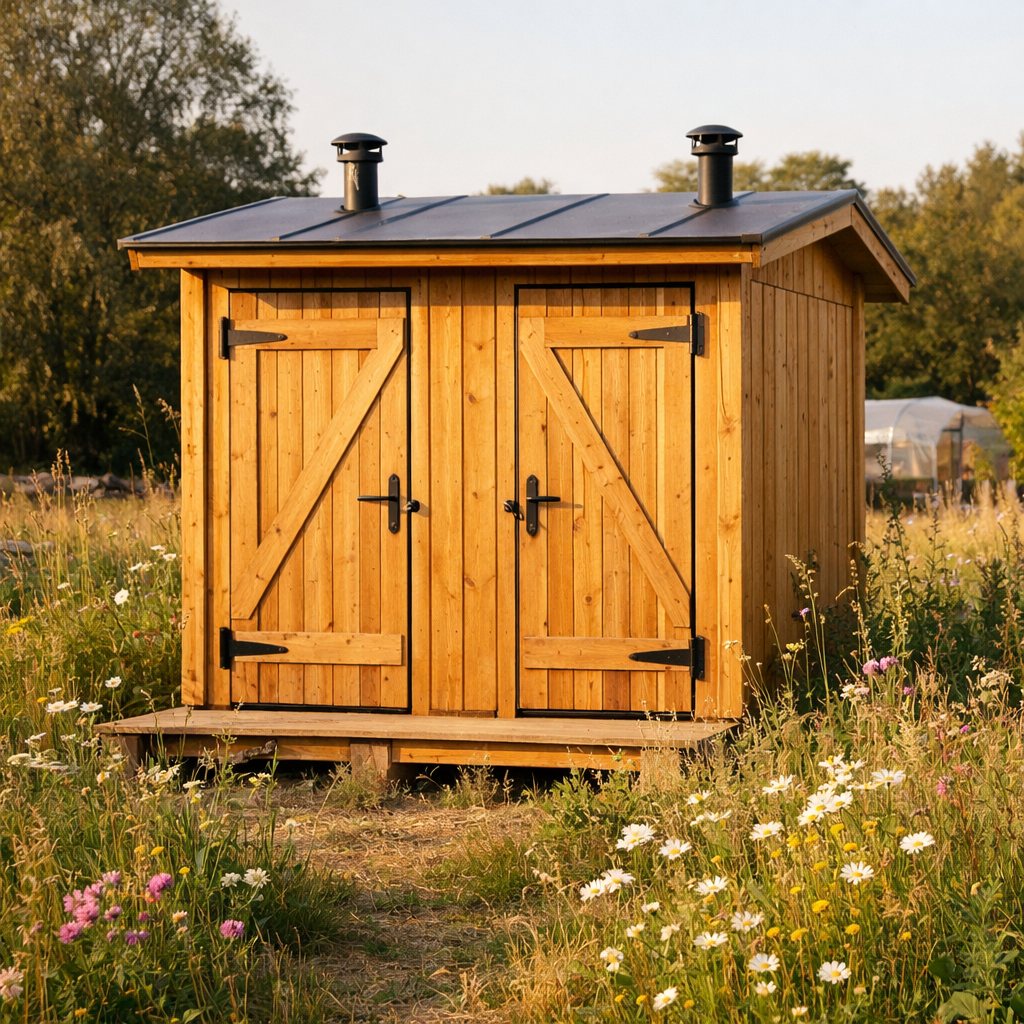
Die große Schwester der Eimerlösung. Zwei Kammern unter dem Sitz werden abwechselnd befüllt. Während die eine sich füllt, rottet die andere in Ruhe durch. Ab etwa zehn Menschen lohnt sich der Sprung.The big sister of the bucket version. Two chambers under the seat are filled in turn. While one fills up, the other rots down in peace. From about ten people onwards the step up pays off.

So wird gebautHow it is built
Gemauerte oder betonierte Kammern mit Zugangsklappe von hinten, Sitzhaus darüber, Abluftkamin auf der Sonnenseite.Chambers of blockwork or concrete with an access hatch at the back, a seat house above them and a vent stack on the sunny side.
KostenCost
800 bis 3.000 Euro800 to 3,000 euros
Erster SchrittFirst step
Standort wählen: erhöht, gut belüftet, mit Zufahrt für die Schubkarre.Choose the site: raised, well aired, with an approach for the wheelbarrow.
Schritt für SchrittStep by step
Zweikammer-Häuschen, Schnitt Platte 320 x 180 100 hoch 120 innen 220 vorne 1 2 3 4 5 6 7 8 9 1 Sitzhaus mit Pultdach 12 Grad 2 Sitzöffnung 30 x 22 cm 3 Trenneinsatz und Kanister 4 Kammer A, in Benutzung 5 Kammer B, ruht ein Jahr 6 Wechsel nach zwölf Monaten 7 Ausräumklappe 80 x 70 cm 8 Abluftrohr DN 100, schwarz 9 Bodenplatte auf Schotter Nicht maßstäblich, Maße in cm
Bauskizze Zweikammer-Häuschen, am Handy seitlich wischenMeasured sketch of Two-chamber toilet house, swipe sideways on a phone

Bevor du anfängst

Ein fest gegründetes Häuschen ist eine bauliche Anlage, deshalb geht der erste Weg zum Bauamt. Stellt dort eine Bauvoranfrage, sie kostet 50 bis 200 Euro und erspart euch eine Fehlplanung. Fragt, was im Außenbereich möglich ist, dort braucht ihr fast immer eine Genehmigung, und verfahrensfrei hieße ohnehin nur, dass niemand vorher prüft. Die zweite Stelle ist die untere Wasserbehörde. Sie verlangt meist eine wasserundurchlässige Bodenplatte und nennt euch den nötigen Abstand zu Brunnen, Quellen und Gewässern. Den Abstand zur Grenze nennt euch das Bauamt. Beim Betrieb ist die Lüftung der wunde Punkt, ein offener Zuluftschlitz und ein Entlüftungsrohr über Dach halten den Raum trocken. Und halte den Unterschied auseinander: verfahrensfrei heißt nur, dass du keinen Antrag stellst. Zulässig ist das Vorhaben damit noch nicht, im Außenbereich liegt genau da die eigentliche Hürde.

Das brauchst du

  • 0,8 m³ Beton C25/30, Baustahlmatte Q188, 2 m³ Schotter 0/32 Bodenplatte und Unterbau
  • 90 Schalungssteine 25 x 25 x 50 cm Außen- und Mittelwand
  • 0,9 m³ Füllbeton C20/25 verfüllt die Steine
  • 2 Klappen aus Lärche, je 80 x 70 cm, mit Riegel zum Ausräumen
  • 6 Kanthölzer 10 x 10 cm, je 210 cm Ständerwerk des Sitzhauses
  • 12 m² Lärchenschalung 20 mm, Nut und Feder Wände und Tür
  • 12 m² Wellblech, Dachlattung 4 x 6 cm Pultdach
  • 2 Siebdruckplatten 21 mm, je 150 x 60 cm Sitzebene über den Kammern
  • 2 Trenneinsätze, 2 Kanister 20 Liter halten die Kammern trocken
  • 2 HT-Rohre DN 100, je 3 m, schwarz Abluftkamine auf der Sonnenseite

Werkzeug

Spaten, Schubkarre, Betonmischer 140 Liter, Rüttelplatte, Maurerkelle, Richtlatte 2 m, Wasserwaage, Maurerschnur, Akkuschrauber, Handkreissäge

Schritt für Schritt

  1. Standort abstecken. Erhöhte, luftige Lage, 3 m zur Grundstücksgrenze, 30 m zu Brunnen und Gewässern. Ein 120 cm breiter Schubkarrenweg muss bis an die Klappen führen.
  2. Grube und Platte. 320 x 180 cm ausheben, 40 cm tief, 25 cm Schotter in zwei Lagen verdichten. Darauf Bretterschalung 15 cm, Baustahlmatte auf Abstandhalter, Beton abziehen, sieben Tage aushärten.
  3. Kammern mauern. Schalungssteine in vier Lagen versetzt auf 100 cm Höhe hochziehen, Innenmaß je Kammer 120 x 120 cm. Die Mittelwand geht dicht durch, nach jeder zweiten Lage Beton einfüllen.
  4. Klappen einbauen. In jeder Rückwand eine Öffnung 80 x 70 cm aussparen, Unterkante 15 cm über der Bodenplatte. Lärchenrahmen einmörteln, Klappe mit zwei Bändern und Riegel.
  5. Decke legen. Kanthölzer 10 x 10 cm im Abstand von 50 cm auflegen, darauf die Siebdruckplatten. Zwei Sitzöffnungen von je 30 x 22 cm mittig über den Kammern aussägen.
  6. Sitzhaus stellen. Ständerwerk 200 x 150 cm, vorne 220 cm hoch, hinten 190 cm, Pultdach mit 12 Grad Gefälle. Schalung waagerecht, unten 2 cm Luft für die Belüftung.
  7. Abluft setzen. Je Kammer ein Rohr DN 100 von der Kammerdecke bis 50 cm über den First, Südseite, schwarz gestrichen, oben Fliegengitter.
  8. Erste Kammer starten. Kammer A 10 cm hoch mit Stroh und Spänen füllen, Kammer B mit einem Brett verschließen. Nach zwölf Monaten wechseln, Kammer A ruht ein weiteres Jahr.

Zeit und Kosten

Drei bis vier Personen, vier bis sechs Wochenenden, etwa 120 Arbeitsstunden. Material 800 Euro mit gebrauchtem Holz und Restblech, bis 3.000 Euro mit neuer Lärche und neuem Dach. Betonmischer und Rüttelplatte kosten je 40 bis 60 Euro Tagesmiete.

Die drei häufigsten Fehler

  • Kammern zu klein. Pro Person fallen im Jahr etwa 250 Liter an. Zehn Menschen brauchen je Kammer mindestens 1,7 m³. Wer 1 m³ baut, muss zu früh wechseln und verliert Rottezeit.
  • Urin nicht abgetrennt. Eine nasse Kammer fault statt zu rotten und stinkt jahrelang. Trenneinsatz einbauen, auch wenn die Kammer groß ist.
  • Klappe zu tief. Sitzt die Unterkante auf Höhe der Bodenplatte, rutscht beim Öffnen alles heraus. Plane 15 cm Schwelle und steck eine Bohle davor.

Before you start

A little house on a permanent foundation is a structure in the eyes of building law, so your first call is the Bauamt (the local building authority). Put in a Bauvoranfrage there, an outline enquiry that costs 50 to 200 euros and saves you from planning the wrong thing. Ask what is possible im Außenbereich (outside the built-up area, where planning law is strict), because out there you almost always need permission, and verfahrensfrei would in any case only mean that nobody checks beforehand. The second office is the untere Wasserbehörde (the lower water authority). It usually asks for a watertight base slab and will tell you the distance you have to keep from wells, springs and open water. The distance to the boundary comes from the Bauamt. In daily use the ventilation is the weak point: an open inlet slot and a vent pipe above the roof keep the room dry. And keep the difference straight: verfahrensfrei only means that you file no application. It does not yet mean the project is allowed, and im Außenbereich that is exactly where the real hurdle lies.

What you need

  • 0.8 m³ of concrete C25/30, Baustahlmatte Q188 (a welded reinforcing mesh), 2 m³ of crushed stone 0/32 base slab and sub-base
  • 90 Schalungssteine (dry-stack concrete formwork blocks) 25 x 25 x 50 cm outer walls and dividing wall
  • 0.9 m³ of infill concrete C20/25 fills the blocks
  • 2 larch hatches, 80 x 70 cm each, with a bolt for emptying
  • 6 Kanthölzer (squared timber posts) 10 x 10 cm, 210 cm each frame of the seat house
  • 12 m² of larch cladding 20 mm, tongue and groove walls and door
  • 12 m² of corrugated sheet, roof battens 4 x 6 cm mono-pitch roof
  • 2 Siebdruckplatten (birch plywood with a resin coating) 21 mm, 150 x 60 cm each seat deck over the chambers
  • 2 separating inserts, 2 canisters of 20 litres keep the chambers dry
  • 2 HT-Rohre DN 100 (grey plastic waste pipe), 3 m each, black vent stacks on the sunny side

Tools

Spade, wheelbarrow, cement mixer 140 litres, plate compactor, bricklayer's trowel, straightedge 2 m, spirit level, bricklayer's line, cordless screwdriver, circular saw

Step by step

  1. Set out the site. A raised, airy spot, 3 m from the boundary, 30 m from wells and open water. A wheelbarrow path 120 cm wide has to reach right up to the hatches.
  2. Pit and slab. Dig out 320 x 180 cm, 40 cm deep, and compact 25 cm of crushed stone in two layers. On top of that a board shutter 15 cm high, the reinforcing mesh on spacers, screed the concrete off and let it cure for seven days.
  3. Lay the chambers. Build the Schalungssteine up to a height of 100 cm in four staggered courses, internal size 120 x 120 cm per chamber. The dividing wall runs through solid, and you pour concrete in after every second course.
  4. Fit the hatches. Leave an opening of 80 x 70 cm in each back wall, its bottom edge 15 cm above the slab. Bed the larch frame in mortar and hang the hatch on two hinges with a bolt.
  5. Lay the deck. Set the Kanthölzer 10 x 10 cm at 50 cm centres and the Siebdruckplatten on top. Cut two seat openings of 30 x 22 cm, each centred over its chamber.
  6. Stand the seat house. A frame of 200 x 150 cm, 220 cm high at the front and 190 cm at the back, with a mono-pitch roof falling at 12 degrees. The cladding runs horizontally, with a gap of 2 cm at the bottom for air.
  7. Set the vents. One pipe DN 100 per chamber, from the chamber ceiling to 50 cm above the ridge, on the south side, painted black, with a fly screen on top.
  8. Start the first chamber. Fill chamber A 10 cm deep with straw and shavings and close chamber B off with a board. Swap over after twelve months, then chamber A rests for another year.

Time and cost

Three to four people, four to six weekends, about 120 hours of work. Materials 800 euros with second-hand timber and leftover sheet, up to 3,000 euros with new larch and a new roof. A cement mixer and a plate compactor cost 40 to 60 euros a day each to hire.

The three most common mistakes

  • Chambers too small. Each person produces about 250 litres a year. Ten people need at least 1.7 m³ per chamber. Build 1 m³ and you have to swap over too early, which costs you rotting time.
  • Urine not separated. A wet chamber putrefies instead of rotting and stinks for years. Fit a separating insert, even when the chamber is large.
  • Hatch set too low. With the bottom edge level with the slab, everything slides out as soon as you open it. Plan a threshold of 15 cm and slot a plank in front of it.

Worauf es ankommtWhat matters hereSobald das Häuschen fest gegründet ist, wird es baurechtlich zur baulichen Anlage. Bauvoranfrage stellen.As soon as the little house sits on a permanent foundation, building law treats it as a structure. Put in a Bauvoranfrage (an outline enquiry at the building authority).

Draußendusche mit Sonnenwärme, Outdoor shower warmed by the sun
Ein WochenendeOne weekendEtwas ÜbungSome practice helps

Draußendusche mit SonnenwärmeOutdoor shower warmed by the sun

2 Personen, Kies rund 0,5 Kubikmeter, schweres Heben2 people, gravel about 0.5 cubic metres, heavy lifting

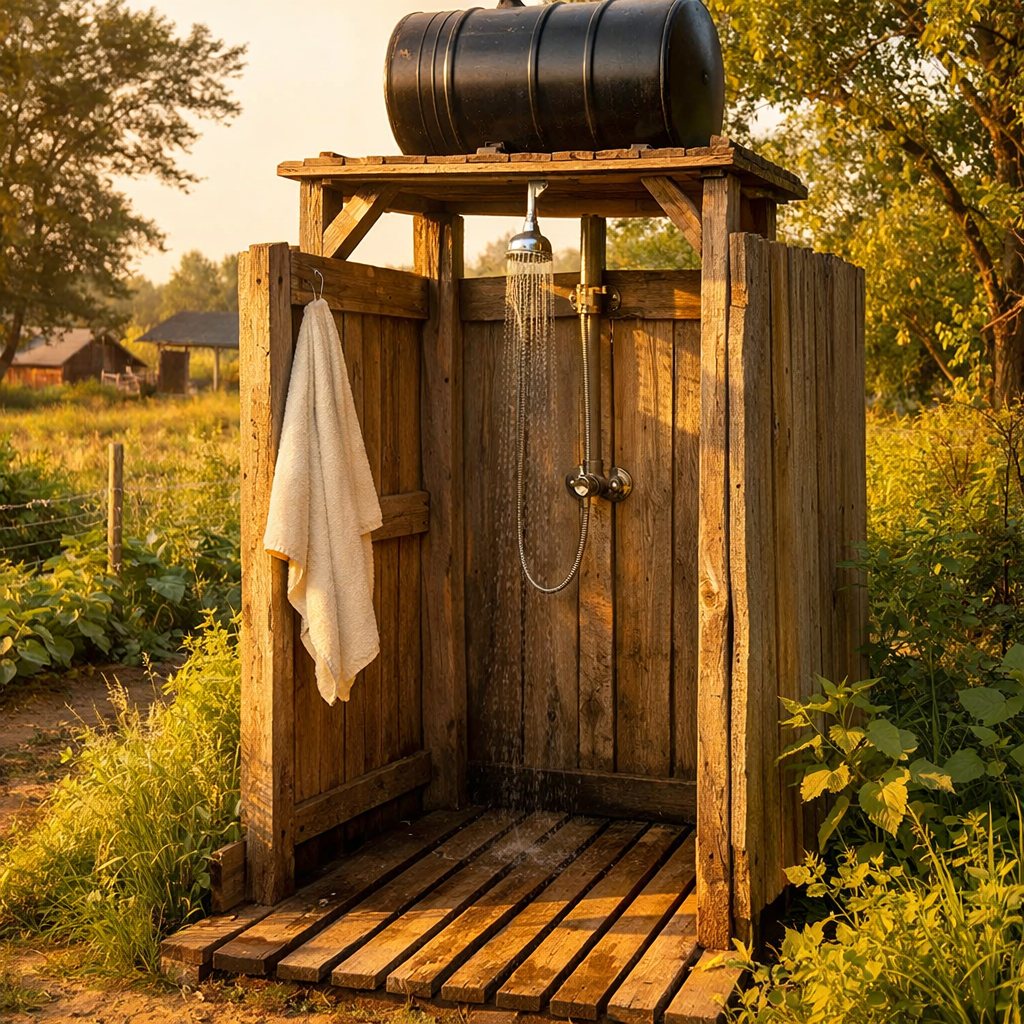
Warm duschen unter freiem Himmel, ohne einen Cent Heizkosten. Ein schwarzer Tank auf dem Dach oder zwanzig Meter schwarzer Gartenschlauch auf einem Blechdach reichen an einem Sommertag für mehrere heiße Duschen.A warm shower under the open sky, without a cent of heating costs. A black tank on the roof, or twenty metres of black garden hose on a sheet metal roof, is enough on a summer day for several hot showers.

So wird gebautHow it is built
Holzrost als Standfläche, Sichtschutz aus geflochtener Weide, darunter eine Sickerpackung aus Kies. Das Grauwasser läuft in ein bepflanztes Beet.A wooden duckboard to stand on, a screen of woven willow, and a soakaway of gravel underneath. The greywater runs into a planted bed.
KostenCost
200 bis 800 Euro200 to 800 euros
Erster SchrittFirst step
Erst den Ablauf planen, dann die Dusche. Wohin das Wasser geht, entscheidet über den Standort.Plan the drainage first, then the shower. Where the water goes decides where the shower stands.
Schritt für SchrittStep by step
Draußendusche mit Sonnenwärme, Schnitt 300 über Rost Rost 116 Grube 150 breit 60 tief 1 2 3 4 5 6 7 8 9 1 Schwarzer Tank 200 Liter 2 Podest, 300 cm über dem Rost 3 PE-Schlauch mit Kugelhahn 4 Sparduschkopf auf 200 cm 5 Weidengeflecht als Sichtschutz 6 Holzrost auf H-Ankern 7 Sickerpackung aus Kies 16/32 8 Geotextil rundum eingeschlagen 9 Ablauf ins Pflanzbeet Nicht maßstäblich, Maße in cm
Bauskizze Draußendusche mit Sonnenwärme, am Handy seitlich wischenMeasured sketch of Outdoor shower warmed by the sun, swipe sideways on a phone

Bevor du anfängst

Die untere Wasserbehörde im Landratsamt ist hier die richtige Adresse, denn Grauwasser ist rechtlich Abwasser. Ruft dort an, bevor ihr grabt, und beschreibt genau, was ihr vorhabt. Eine gelegentliche Gießkanne aufs Beet stört niemanden, sobald ihr aber dauerhaft sammelt, leitet oder versickert, ist das eine Gewässerbenutzung und braucht eine Erlaubnis nach Paragraf 8 Wasserhaushaltsgesetz. Das gilt auch bei einem einzigen Haushalt, und die Auslegung schwankt zwischen den Ländern stark. In den Wasserschutzzonen I und II ist die Versickerung verboten. Die offene Dusche selbst ist meist verfahrensfrei, was nicht heißt, dass jeder Standort zulässig wäre. Im Sacktank drohen über 60 Grad, mischt kaltes Wasser bei.

Das brauchst du

  • 1 schwarzer Tank 200 Liter oder 20 m schwarzer Gartenschlauch 3/4 Zoll Sonnenkollektor
  • 4 Kanthölzer 9 x 9 cm, je 250 cm Eckpfosten des Gestells
  • 4 H-Anker 91 mm auf 4 Betonplatten 40 x 40 cm halten die Pfosten trocken
  • 8 Lärchenbretter 3 x 12 cm, 4 Kanthölzer 6 x 8 cm Rahmen und Belag des Rosts
  • 6 m² Weidengeflecht, Höhe 180 cm Sichtschutz auf drei Seiten
  • 1 Sparduschkopf, 1 Kugelhahn 1/2 Zoll, 3 m PE-Schlauch Armatur und Leitung
  • 0,5 m³ Kies 16/32, 6 m² Geotextil Sickerpackung unter dem Rost
  • 1 KG-Rohr DN 100, 3 m, Bogen 45 Grad führt das Grauwasser ins Pflanzbeet
  • 60 Spax 6 x 100 mm, 40 Spax 4 x 50 mm Verschraubungen
  • Kernseife ohne synthetische Tenside damit das Sickerbeet arbeitet

Werkzeug

Spaten, Schubkarre, Akkuschrauber, Handkreissäge, Wasserwaage, Zollstock, Schlagbohrmaschine mit 10er Steinbohrer

Schritt für Schritt

  1. Ablauf zuerst planen. Eine Dusche verbraucht 30 bis 40 Liter. Für das Grauwasser rechnest du 2 m² Pflanzbeet je täglich duschender Person, bepflanzt mit Weide, Schilf oder Minze.
  2. Sickergrube ausheben. 150 x 150 cm, 60 cm tief. Geotextil auslegen, 45 cm Kies einfüllen, Vlies oben überschlagen. Vom Tiefpunkt ein KG-Rohr mit 2 cm Gefälle je Meter zum Beet legen.
  3. Pfosten setzen. Vier H-Anker im Quadrat 120 x 120 cm auf die Betonplatten dübeln. Pfosten einstellen, mit der Wasserwaage loten, je vier Spax 6 x 100 mm.
  4. Rost bauen. Rahmen aus den Kanthölzern 6 x 8 cm, außen 116 x 116 cm, Ecken mit je zwei Spax 6 x 100 mm. Bretter mit 1 cm Fuge aufschrauben.
  5. Tank hochsetzen. Der Tank steht auf einem Blechdach oder Podest, mindestens 300 cm über dem Rost. Voll wiegt er 200 kg, der Unterbau muss 250 kg tragen.
  6. Leitung anschließen. PE-Schlauch vom Tankauslass nach unten führen, Kugelhahn auf 110 cm, Duschkopf auf 200 cm Höhe, alles mit Schlauchschellen sichern. Bei der Schlauchvariante 20 m aufs Blechdach legen.
  7. Sichtschutz und Test. Weidengeflecht auf drei Seiten, Unterkante 20 cm über dem Rost, damit Luft zieht. Tank morgens füllen, an einem klaren Sommertag misst du nachmittags 40 bis 55 Grad.
  8. Winterfest machen. Ab Oktober Tank und Schlauch restlos entleeren, Kugelhahn offen stehen lassen. Ein voller Schlauch platzt beim ersten Frost.

Zeit und Kosten

Zwei Personen, ein Wochenende, etwa zwölf Arbeitsstunden, davon vier für die Sickergrube. Material 200 Euro mit gebrauchtem Tank und Restholz, bis 800 Euro mit neuer Lärche, Weidengeflecht und guten Armaturen.

Die drei häufigsten Fehler

  • Ablauf vergessen. Wer erst die Dusche baut, steht danach im Matsch. 40 Liter am Tag machen aus 2 m² Lehmboden in einer Woche eine Pfütze. Sickerpackung und Beet kommen zuerst.
  • Falsche Seife. Duschgel mit synthetischen Tensiden setzt das Sickerbeet zu, nach einer Saison steht das Wasser. Kernseife oder ausgewiesen abbaubares Duschbad nehmen.
  • Tank zu tief. Hängt der Tank nur 50 cm über dem Kopf, tröpfelt es. Du brauchst 250 bis 300 cm Höhenunterschied, sonst hilft nur eine 12-Volt-Pumpe.

Before you start

The untere Wasserbehörde (the lower water authority at the Landratsamt, your district office) is the right address here, because in law greywater counts as sewage. Ring them before you dig and describe exactly what you have in mind. The odd watering can emptied onto a bed bothers nobody, but as soon as you collect, pipe or soak away water permanently, that counts as a use of a body of water and needs a permit under Section 8 of the Wasserhaushaltsgesetz (the federal water act). This applies to a single household as well, and the reading of it varies a lot between the federal states. In Wasserschutzzone I and II (the two innermost zones of a drinking water protection area) soaking water away is forbidden. The open shower itself is usually verfahrensfrei (exempt from the permit procedure), which does not mean that every site is allowed. In a black bag tank the water can pass 60 degrees, so mix cold water in.

What you need

  • 1 black tank of 200 litres or 20 m of black garden hose, 3/4 inch solar collector
  • 4 Kanthölzer (squared timber posts) 9 x 9 cm, 250 cm each corner posts of the frame
  • 4 H-Anker (galvanised H-shaped post anchors) 91 mm on 4 concrete slabs 40 x 40 cm keep the posts dry
  • 8 larch boards 3 x 12 cm, 4 Kanthölzer 6 x 8 cm frame and deck of the duckboard
  • 6 m² of woven willow screening, 180 cm high privacy screen on three sides
  • 1 low flow shower head, 1 ball valve 1/2 inch, 3 m of PE hose fittings and pipework
  • 0.5 m³ of gravel 16/32, 6 m² of geotextile soakaway under the duckboard
  • 1 KG-Rohr DN 100 (orange plastic underground drainage pipe), 3 m, one bend of 45 degrees carries the greywater to the planted bed
  • 60 Spax screws 6 x 100 mm, 40 Spax screws 4 x 50 mm fixings
  • Kernseife (plain curd soap) with no synthetic surfactants so the soakaway bed keeps working

Tools

Spade, wheelbarrow, cordless screwdriver, circular saw, spirit level, folding rule, hammer drill with a masonry bit of 10 mm

Step by step

  1. Plan the drainage first. One shower uses 30 to 40 litres. For the greywater, allow 2 m² of planted bed for every person who showers daily, planted with willow, reed or mint.
  2. Dig the soakaway. 150 x 150 cm, 60 cm deep. Line it with geotextile, fill in 45 cm of gravel and fold the fabric over the top. From the low point, run a KG-Rohr to the bed with 2 cm of fall per metre.
  3. Set the posts. Bolt four H-Anker onto the concrete slabs in a square of 120 x 120 cm. Stand the posts in them, plumb them with the spirit level and fix each one with four Spax 6 x 100 mm.
  4. Build the duckboard. A frame from the Kanthölzer 6 x 8 cm, 116 x 116 cm on the outside, each corner with two Spax 6 x 100 mm. Screw the boards down with a gap of 1 cm between them.
  5. Get the tank up high. The tank sits on a sheet metal roof or a platform, at least 300 cm above the duckboard. Full it weighs 200 kg, so the structure under it has to carry 250 kg.
  6. Connect the pipework. Run the PE hose down from the tank outlet, ball valve at 110 cm, shower head at 200 cm, everything held with hose clips. With the hose version, lay the 20 m out on the sheet metal roof.
  7. Screen and test. Willow screening on three sides, its bottom edge 20 cm above the duckboard so that air can move. Fill the tank in the morning, and on a clear summer day you will measure 40 to 55 degrees by the afternoon.
  8. Make it ready for winter. From October, drain the tank and the hose completely and leave the ball valve open. A full hose bursts with the first frost.

Time and cost

Two people, one weekend, about twelve hours of work, four of them for the soakaway. Materials 200 euros with a second-hand tank and offcuts, up to 800 euros with new larch, willow screening and good fittings.

The three most common mistakes

  • Drainage forgotten. Build the shower first and you will be standing in mud afterwards. Forty litres a day turn 2 m² of clay soil into a puddle within a week. The soakaway and the bed come first.
  • The wrong soap. Shower gel with synthetic surfactants clogs the soakaway bed, and after one season the water stands. Use Kernseife or a shower product declared as biodegradable.
  • Tank too low. With the tank only 50 cm above your head, all you get is a trickle. You need 250 to 300 cm of height difference, otherwise only a 12 volt pump will help.

Worauf es ankommtWhat matters hereNur biologisch abbaubare Seife verwenden, sonst kippt das Sickerbeet innerhalb einer Saison.Use only biodegradable soap, otherwise the soakaway bed turns sour within one season.

Regenwasser sammeln, Collecting rainwater
Ein WochenendeOne weekendEtwas ÜbungSome practice helps

Regenwasser sammelnCollecting rainwater

2 Personen, leerer Behälter etwa 60 kg, schweres Heben2 people, empty container about 60 kg, heavy lifting

Ein Millimeter Regen auf hundert Quadratmeter Dach sind hundert Liter Wasser. Bei 700 Millimetern Jahresniederschlag laufen über ein einziges Scheunendach 70.000 Liter, die sonst im Boden verschwinden.One millimetre of rain on a hundred square metres of roof is a hundred litres of water. With 700 millimetres of rainfall a year, 70,000 litres run off a single barn roof that would otherwise vanish into the ground.

So wird gebautHow it is built
Dachrinne, Laubfang, Erstverschmutzungsfilter, IBC-Tanks in Reihe oder eine Erdzisterne. Überlauf immer in eine Versickerungsmulde führen.Gutter, leaf trap, first flush filter, IBC tanks in a row or an underground cistern. Always lead the overflow into a soakaway hollow.
KostenCost
150 Euro pro IBC-Tank, 2.500 Euro aufwärts für eine Zisterne150 euros per IBC tank, 2,500 euros upwards for a cistern
Erster SchrittFirst step
Dachflächen ausmessen und mit dem örtlichen Jahresniederschlag multiplizieren. Die Zahl überrascht fast immer.Measure your roof areas and multiply by the local annual rainfall. The number almost always comes as a surprise.
Schritt für SchrittStep by step
Regenwasser sammeln, Schnitt Dachfläche 12 x 8 m IBC 120 breit 116 hoch Mulde 200 lang 1 2 3 4 5 6 7 8 9 1 Dachfläche und Regenrinne 2 Laubfangkorb in der Rinne 3 Regensammler mit Filter 4 Erstspülung, erste acht Liter 5 IBC 1.000 Liter, abgedunkelt 6 Kopplung unten, KG DN 50 7 Kugelhahn und Gartenpumpe 8 Überlauf DN 100 mit Gefälle 9 Mulde mit Kies und Geotextil Nicht maßstäblich, Maße in cm
Bauskizze Regenwasser sammeln, am Handy seitlich wischenMeasured sketch of Collecting rainwater, swipe sideways on a phone

Bevor du anfängst

Regenwasser vom eigenen Dach im Garten zu nutzen ist genehmigungsfrei. Sobald es ins Haus geht, etwa zur Toilettenspülung oder zur Waschmaschine, meldet ihr die Anlage beim Gesundheitsamt an, das verlangt die Trinkwasserverordnung, in der Regel vier Wochen vor Baubeginn. Sagt eurem Wasserversorger im selben Zug Bescheid. Die Frage an das Gesundheitsamt lautet, wie ihr die Trennung nachweist. Regenwasserleitungen bleiben dauerhaft und sichtbar als kein Trinkwasser gekennzeichnet, ein Rückfluss ins Netz ist verboten. Genau dieser Rückfluss ist die Gefahr, weil er die Hausinstallation der Nachbarschaft verkeimt. Fragt bei der Gemeinde nach der Niederschlagswassergebühr, wer nachweislich versickert, bekommt oft einen erheblichen Teil erlassen.

Das brauchst du

  • 3 bis 4 IBC-Container 1.000 Liter, lebensmittelecht Speicher, gebraucht ab 60 Euro
  • 1 Regensammler mit Filter, 1 Laubfangkorb holen das Wasser sauber aus dem Fallrohr
  • 1 KG-Rohr DN 100, 1 m, mit Endkappe Erstspülung für die ersten acht Liter
  • 4 Tankverschraubungen 2 Zoll, 6 m KG-Rohr DN 50 koppelt die Tanks
  • 1 Kugelhahn 2 Zoll mit Verschraubung Entnahme am letzten Tank
  • 8 Betonplatten 40 x 40 cm, 0,3 m³ Splitt Unterbau, voller Tank wiegt 1.030 kg
  • 4 lichtdichte Hauben oder 12 m² schwarze Folie gegen Algen
  • 1 KG-Rohr DN 100, 3 m, zwei Bögen 45 Grad Überlauf in die Mulde
  • 1 m³ Kies 16/32, 6 m² Geotextil Versickerungsmulde
  • 1 Gartenpumpe 800 Watt mit Druckschalter Entnahme mit Druck

Werkzeug

Zollstock, Wasserwaage, Akkuschrauber, Lochsäge 68 mm und 105 mm, Stichsäge, Rohrzange, Spaten, Silikonpistole

Schritt für Schritt

  1. Dach rechnen. Miss die Grundfläche, nicht die Schräge. Eine Scheune 12 x 8 m hat 96 m². Bei 700 mm Jahresniederschlag sind das 67.000 Liter, abzüglich 20 Prozent Verlust rund 54.000 Liter.
  2. Speicher festlegen. Rechne 4 bis 6 Prozent des Jahresertrags als Tankvolumen, hier 2.000 bis 3.000 Liter. Wer den ganzen Sommer überbrücken will, plant das Dreifache.
  3. Standplatz bauen. Betonplatten in ein 10 cm dickes Splittbett legen und in beide Richtungen ausrichten. Über die ganze Reihe darf der Höhenunterschied 5 mm nicht überschreiten.
  4. Regensammler einbauen. Rinne säubern, Gefälle 3 mm je Meter prüfen, Laubfangkorb einsetzen. Im Fallrohr auf Höhe der Tankoberkante 8 cm heraussägen, Sammler einsetzen, Schlauch zum Tankdeckel führen.
  5. Erstspülung setzen. Vor dem Sammler ein senkrechtes KG-Rohr mit Kappe unten anbringen. Es fängt die ersten acht Liter mit dem Dachstaub. Nach jedem längeren Regen leeren.
  6. Tanks koppeln. In jeden IBC unten eine Tankverschraubung 2 Zoll setzen, alle Tanks über KG DN 50 auf gleicher Höhe verbinden. Am letzten Tank sitzt der Kugelhahn.
  7. Überlauf führen. Oben am ersten Tank ein Loch mit der Lochsäge 105 mm bohren. Rohr DN 100 mit 2 cm Gefälle je Meter in eine Mulde 200 x 100 x 50 cm mit Geotextil und Kies.
  8. Abdunkeln und überwintern. Tanks lichtdicht einpacken, Öffnungen mit Fliegengitter gegen Mücken. Ab November oben 20 cm frei lassen oder entleeren, Eis sprengt jede Verschraubung.

Zeit und Kosten

Zwei Personen, ein Wochenende, zehn bis vierzehn Stunden. Vier gebrauchte IBC kosten 240 bis 600 Euro, der Regensammler 30 Euro, Rohre und Verschraubungen etwa 120 Euro. Eine Erdzisterne mit 6.000 Litern kostet 2.500 bis 5.000 Euro plus Bagger.

Die drei häufigsten Fehler

  • Tank auf weichem Boden. 1.030 kg sacken in der Wiese schief ein und reißen die Verschraubung ab. Betonplatten in ein Splittbett legen und waagerecht ausrichten.
  • Überlauf zu klein. Bei Starkregen kommen über 96 m² Dach in zehn Minuten 400 Liter. Ein 32er Schlauch schafft das nicht, das Wasser steht dann an der Hauswand.
  • Licht am Tank. Ein durchscheinender IBC veralgt in vier Wochen, das Wasser stinkt und verstopft jede Düse. Lichtdicht abdecken, auch die Deckelöffnung.

Before you start

Using rainwater from your own roof in the garden needs no permission. As soon as it goes into the house, for flushing the toilet or feeding the washing machine, you register the system with the Gesundheitsamt (the public health office), which the Trinkwasserverordnung (the German drinking water ordinance) requires, as a rule four weeks before work starts. Tell your water supplier at the same time. The question for the Gesundheitsamt is how you prove the separation. Rainwater pipes stay marked, permanently and visibly, as Kein Trinkwasser (not drinking water), and any backflow into the mains is forbidden. That backflow is the real danger, because it carries germs into the plumbing of the whole neighbourhood. Ask your Gemeinde (local council) about the Niederschlagswassergebühr, the charge for rainwater run-off. Anyone who can show that the water soaks away on site often gets a good part of it waived.

What you need

  • 3 to 4 IBC containers of 1,000 litres, food grade storage, from 60 euros second-hand
  • 1 rain collector with filter, 1 leaf basket take clean water out of the downpipe
  • 1 KG-Rohr DN 100 (orange plastic underground drainage pipe), 1 m, with an end cap first flush trap for the first eight litres
  • 4 tank connectors 2 inch, 6 m of KG-Rohr DN 50 links the tanks together
  • 1 ball valve 2 inch with union draw-off point on the last tank
  • 8 concrete slabs 40 x 40 cm, 0.3 m³ of grit base, a full tank weighs 1,030 kg
  • 4 lightproof covers or 12 m² of black sheeting against algae
  • 1 KG-Rohr DN 100, 3 m, two bends of 45 degrees overflow into the hollow
  • 1 m³ of gravel 16/32, 6 m² of geotextile soakaway hollow
  • 1 garden pump 800 watt with a pressure switch water under pressure

Tools

Folding rule, spirit level, cordless screwdriver, hole saws 68 mm and 105 mm, jigsaw, pipe wrench, spade, silicone gun

Step by step

  1. Work out the roof. Measure the footprint, not the slope. A barn of 12 x 8 m gives 96 m². At 700 mm of rain a year that is 67,000 litres, and after 20 per cent of losses around 54,000 litres.
  2. Decide on the storage. Allow 4 to 6 per cent of the annual yield as tank volume, so 2,000 to 3,000 litres here. If you want to get through a whole summer, plan for three times that.
  3. Build the standing area. Lay the concrete slabs on a bed of grit 10 cm thick and level them in both directions. Across the whole row the difference in height must stay under 5 mm.
  4. Fit the rain collector. Clean the gutter, check that it falls 3 mm per metre and drop the leaf basket in. Cut 8 cm out of the downpipe at the height of the top of the tank, fit the collector and run the hose to the tank lid.
  5. Set up the first flush. Ahead of the collector, fit an upright KG-Rohr with a cap at the bottom. It catches the first eight litres along with the dust off the roof. Empty it after every longer spell of rain.
  6. Link the tanks. Fit a tank connector of 2 inch low down in every IBC and join all the tanks at the same height with KG DN 50. The ball valve sits on the last tank.
  7. Run the overflow. Cut a hole high up in the first tank with the hole saw 105 mm. Take a pipe DN 100 with 2 cm of fall per metre into a hollow of 200 x 100 x 50 cm lined with geotextile and filled with gravel.
  8. Keep the light out and get through winter. Wrap the tanks so that no light reaches the water and cover the openings with fly screen against mosquitoes. From November, leave the top 20 cm empty or drain the tanks, because ice splits any fitting.

Time and cost

Two people, one weekend, ten to fourteen hours. Four second-hand IBCs cost 240 to 600 euros, the rain collector 30 euros, pipes and fittings about 120 euros. A underground cistern of 6,000 litres costs 2,500 to 5,000 euros plus the digger.

The three most common mistakes

  • Tank on soft ground. On a meadow, 1,030 kg sinks in unevenly and tears the fitting off. Lay concrete slabs on a bed of grit and level them.
  • Overflow too small. In heavy rain, 96 m² of roof delivers 400 litres in ten minutes. A hose of 32 mm cannot cope, and the water ends up standing against the wall of the house.
  • Light on the tank. A translucent IBC goes green within four weeks, the water starts to smell and it blocks every nozzle. Cover it against light, the lid opening included.

Worauf es ankommtWhat matters hereTanks lichtdicht abdecken, sonst veralgt das Wasser. Im Winter entleeren oder frostfrei aufstellen.Cover the tanks so that no light gets in, otherwise the water goes green with algae. In winter, drain them or stand them somewhere free of frost.

Pflanzenkläranlage, Reed bed treatment system
Längeres VorhabenA longer projectMit erfahrener HandNeeds an experienced hand

PflanzenkläranlageReed bed treatment system

4 bis 6 Personen plus Baggerfahrer und Ingenieurbüro, schweres Heben4 to 6 people plus a digger driver and an engineering firm, heavy lifting

Schilf, Kies und Bodenbakterien reinigen euer Grauwasser besser, als die meisten erwarten. Für Gemeinschaften im Außenbereich ohne Kanalanschluss ist das oft die einzige dauerhaft genehmigungsfähige Lösung.Reed, gravel and soil bacteria clean your greywater better than most people expect. For communities out in the Außenbereich (the open countryside) with no sewer connection, this is often the only solution that gets a permit for the long term.

So wird gebautHow it is built
Vorklärung, dann ein abgedichtetes, bepflanztes Bodenfilterbeet. Faustzahl: rund fünf Quadratmeter Beet pro Person.Primary settlement first, then a sealed, planted soil filter bed. Rule of thumb: about five square metres of bed per person.
KostenCost
4.000 bis 15.000 Euro je nach Größe4,000 to 15,000 euros depending on size
Erster SchrittFirst step
Zur unteren Wasserbehörde gehen, bevor irgendetwas gegraben wird. Ohne wasserrechtliche Erlaubnis geht hier nichts.Go to the untere Wasserbehörde (the lower water authority) before anything is dug. Without a permit under water law, nothing happens here.
Schritt für SchrittStep by step
Pflanzenkläranlage, Schnitt 110 tief Beet 50 m², 8 m lang 70 Filterkies Grube 300 lang 1 2 3 4 5 6 7 8 9 1 Zulauf vom Haus 2 Dreikammergrube 6.000 Liter 3 Pumpe und Schwallbeschicker 4 Verteilrohr in Kies 16/32 5 Filterkies 2/8, 70 cm hoch 6 Schilf, fünf Stück je m² 7 EPDM-Folie auf Schutzvlies 8 Sammelrohr mit 0,5 % Gefälle 9 Ablaufschacht für die Probe Nicht maßstäblich, Maße in cm
Bauskizze Pflanzenkläranlage, am Handy seitlich wischenMeasured sketch of Reed bed treatment system, swipe sideways on a phone

Bevor du anfängst

Ohne wasserrechtliche Erlaubnis der unteren Wasserbehörde geht hier nichts, Grundlage sind Paragraf 8 und 57 Wasserhaushaltsgesetz. Fragt dort zuerst, ob eure Gemeinde einen Anschlusszwang an den Kanal hat, denn davon müsst ihr befreit werden, und das gelingt nur in engen Ausnahmefällen. Bringt eine Fachplanung mit, die zeigt, dass Vorbehandlung, Bemessung und Wartung dem DWA Arbeitsblatt A 262 entsprechen, gerechnet mit vier bis fünf Quadratmetern Beet je Einwohner. Eine bauaufsichtliche Zulassung braucht nur eine serienmäßig gefertigte Anlage, ein selbst gebautes Beet nicht. Der Vorklärschacht ist die Gefahrenstelle. Er wird abgedeckt und gesichert, und niemand steigt allein hinein.

Das brauchst du

  • 1 Dreikammergrube aus Beton, 6.000 Liter Vorklärung, sonst setzt sich der Filter zu
  • 50 m² EPDM-Folie 1,5 mm, 60 m² Schutzvlies dichtet das Beet ab
  • 35 m³ gewaschener Filterkies 2/8 mm Filterkörper, Schichthöhe 70 cm
  • 5 m³ Drainagekies 16/32 Verteilschicht oben, Sammelschicht unten
  • 250 Schilfpflanzen, 5 Stück je m² wurzeln den Filter durch
  • 30 m KG-Rohr DN 100, 20 m Drainagerohr gelocht Zulauf, Verteilung, Sammlung
  • 2 Kontrollschächte DN 400, 1 Ablaufschacht zum Spülen und für die Wasserprobe
  • 1 Schwallbeschicker 200 Liter oder Pumpe gibt das Wasser stoßweise auf
  • 1 Fachplanung durch ein Ingenieurbüro Bemessung, Antrag, Abnahme
  • 1 Bagger 5 Tonnen, drei Tage Miete Aushub und Kiestransport

Werkzeug

Rotationslaser oder Schlauchwaage, Rüttelplatte, Schubkarre, Spaten, Rechen, Bohlen als Fahrweg, Cuttermesser, Rohrzange

Schritt für Schritt

  1. Zur Behörde gehen. Vor dem ersten Spatenstich zur unteren Wasserbehörde. Du brauchst eine wasserrechtliche Erlaubnis nach Paragraf 8 und 57 WHG. Nimm Lageplan, Personenzahl und Bodenaufschluss mit.
  2. Bemessen lassen. Nach Arbeitsblatt DWA-A 262 rechnest du 4 bis 5 m² Beet je Einwohnerwert, zehn Menschen brauchen also 40 bis 50 m². Das Ingenieurbüro liefert die Unterlagen für 1.500 Euro aufwärts.
  3. Vorklärung setzen. Dreikammergrube in eine Grube 300 x 250 x 250 cm auf 20 cm Sandbett stellen, Zulauf mit 2 cm Gefälle je Meter. Der Schlamm wird alle ein bis zwei Jahre abgefahren.
  4. Beet ausheben. 50 m² Fläche, 110 cm tief, Sohle mit dem Laser auf 2 cm genau waagerecht. Böschung 1 zu 1,5, Sohle von Steinen befreien und mit 5 cm Sand abgleichen.
  5. Abdichten. Schutzvlies auslegen, darauf die EPDM-Folie in einem Stück. Ränder 30 cm über Gelände hochziehen und in einen Graben einschlagen. Rohrdurchführungen nur mit Folienflansch.
  6. Filter aufbauen. Unten 15 cm Kies 16/32 mit dem Sammelrohr, Gefälle 0,5 Prozent zum Ablaufschacht. Darüber 70 cm Filterkies 2/8, oben 15 cm Kies mit dem Verteilrohr. Nur über Bohlen fahren.
  7. Beschickung einbauen. Der Filter arbeitet nur stoßweise. Pumpe oder Schwallbeschicker gibt vier bis acht Mal am Tag je 200 Liter ab. Nur so kommt Luft zwischen die Körner.
  8. Bepflanzen und abnehmen. 250 Schilfhalme im Raster 50 x 50 cm setzen, 10 cm tief, am besten von April bis Juni. Anlage abnehmen lassen, danach jährlich warten und Schlammspiegel messen.

Zeit und Kosten

Planung und Genehmigung dauern drei bis neun Monate. Der Bau mit Bagger und vier bis sechs Helfern braucht acht bis zwölf Tage. Kosten 4.000 Euro bei viel Eigenleistung, bis 15.000 Euro schlüsselfertig für zehn Personen. Dazu 150 bis 300 Euro Wartung im Jahr, 250 Euro für die Schlammabfuhr.

Die drei häufigsten Fehler

  • Ohne Vorklärung gebaut. Feststoffe verstopfen den Filter innerhalb eines Jahres. Dann hilft nur noch, den Kies komplett auszutauschen, teurer als die ganze Grube.
  • Falscher Kies. Ungewaschener Kies mit Feinanteil dichtet den Filter ab. Verlange gewaschenen Filterkies 2/8 mit Schlämmkorn unter 1 Prozent und lass dir das Prüfzeugnis geben.
  • Dauerbeschickung. Wer das Wasser gleichmäßig einlaufen lässt, bekommt einen sauerstoffarmen Filter, der stinkt und schlecht reinigt. Stoßweise beschicken, mehrmals täglich.

Before you start

Nothing happens here without a permit under water law from the untere Wasserbehörde (the lower water authority), granted on the basis of Sections 8 and 57 of the Wasserhaushaltsgesetz (the federal water act). Ask there first whether your Gemeinde (local council) has an Anschlusszwang, a duty to connect to the public sewer, because you have to be released from it, and that only works in narrow exceptional cases. Bring a professional design showing that pre-treatment, sizing and maintenance follow the code of practice DWA-A 262, worked out with four to five square metres of bed per person. Only a factory-built system needs a building inspectorate approval, a bed you build yourselves does not. The settlement chamber is the dangerous spot. It gets covered and secured, and nobody climbs into it alone.

What you need

  • 1 Dreikammergrube (three-chamber settlement tank) in concrete, 6,000 litres primary settlement, without it the filter clogs
  • 50 m² of EPDM liner 1.5 mm, 60 m² of protective fleece seals the bed
  • 35 m³ of washed filter gravel 2/8 mm the filter body, 70 cm deep
  • 5 m³ of drainage gravel 16/32 distribution layer on top, collection layer at the bottom
  • 250 reed plants, 5 per m² root right through the filter
  • 30 m of KG-Rohr DN 100 (orange plastic underground drainage pipe), 20 m of perforated land drain inlet, distribution and collection
  • 2 inspection chambers DN 400, 1 outlet chamber for flushing and for the water sample
  • 1 tipping doser of 200 litres or a pump feeds the water on in surges
  • 1 professional design by an engineering firm sizing, application and sign-off
  • 1 digger of 5 tonnes, hired for three days excavation and moving the gravel

Tools

Rotating laser or water level, plate compactor, wheelbarrow, spade, rake, planks to run the barrow on, utility knife, pipe wrench

Step by step

  1. Go to the authority. Before the first spade goes in, visit the untere Wasserbehörde. You need a permit under water law, under Sections 8 and 57 of the Wasserhaushaltsgesetz. Take a site plan, the number of people and a soil survey with you.
  2. Have it sized. Following the code of practice DWA-A 262 you allow 4 to 5 m² of bed per population equivalent, so ten people need 40 to 50 m². The engineering firm supplies the paperwork from 1,500 euros upwards.
  3. Set the settlement tank. Stand the Dreikammergrube in a pit of 300 x 250 x 250 cm on a bed of sand 20 cm thick, with the inlet falling 2 cm per metre. The sludge is taken away every one to two years.
  4. Dig the bed. An area of 50 m², 110 cm deep, the base levelled to within 2 cm with the laser. Batter the sides 1 to 1.5, clear the base of stones and true it up with 5 cm of sand.
  5. Seal it. Lay the protective fleece, then the EPDM liner in one piece. Bring the edges 30 cm above ground level and tuck them into a trench. Pipes pass through with a liner flange only.
  6. Build the filter up. At the bottom 15 cm of gravel 16/32 with the collection pipe, falling 0.5 per cent towards the outlet chamber. Above that 70 cm of filter gravel 2/8, on top 15 cm of gravel with the distribution pipe. Drive over planks only.
  7. Fit the dosing. The filter works in surges only. A pump or a tipping doser releases 200 litres four to eight times a day. That is the only way air gets between the grains.
  8. Plant it and have it signed off. Set 250 reed shoots on a grid of 50 x 50 cm, 10 cm deep, best between April and June. Have the system signed off, then service it once a year and measure the sludge level.

Time and cost

Design and permission take three to nine months. Building it with a digger and four to six helpers takes eight to twelve days. Costs run from 4,000 euros if you do much of the work yourselves, up to 15,000 euros for a turnkey system for ten people. Add 150 to 300 euros of servicing a year and 250 euros for having the sludge taken away.

The three most common mistakes

  • Built without primary settlement. Solids block the filter within a year. Then the only cure is to replace the gravel completely, which costs more than the whole tank.
  • The wrong gravel. Unwashed gravel with fines in it seals the filter up. Insist on washed filter gravel 2/8 with a fines content under 1 per cent and ask for the test certificate.
  • Feeding it non-stop. Let the water run in at a steady trickle and you get a filter short of oxygen that smells and cleans badly. Feed it in surges, several times a day.

Worauf es ankommtWhat matters hereFachplanung ist Pflicht. Manche Bundesländer genehmigen Pflanzenkläranlagen bereitwillig, andere sehr ungern. Das vorher zu wissen spart Monate.A professional design is compulsory. Some federal states grant permission for reed beds readily, others very reluctantly. Knowing which before you start saves months.

Brunnen und Handpumpe, Well and hand pump
Wochen bis MonateWeeks to monthsMit erfahrener HandNeeds an experienced hand

Brunnen und HandpumpeWell and hand pump

2 kräftige Personen, Schlaggewicht 15 kg, schweres Heben2 strong people, driving weight 15 kg, heavy lifting

Eigenes Wasser macht unabhängig. Ein Gartenbrunnen für Gießwasser ist meist mit einer Anzeige erledigt. Trinkwasser ist eine ganz andere Liga und braucht regelmäßige Laboruntersuchungen.Your own water makes you independent. A garden well for watering is usually settled with a simple notification. Drinking water is a different matter altogether and needs regular tests in a laboratory.

So wird gebautHow it is built
Rammbrunnen bis etwa acht Meter im Eigenbau, tiefer nur mit Bohrfirma. Schwengelpumpe braucht keinen Strom und fällt nie aus.A Rammbrunnen (a well driven in with a hammer weight) down to about eight metres is within reach yourself, anything deeper needs a drilling firm. A hand lever pump needs no electricity and never fails.
KostenCost
400 Euro Rammbrunnen, 3.000 bis 8.000 Euro Bohrbrunnen400 euros for a driven well, 3,000 to 8,000 euros for a drilled well
Erster SchrittFirst step
Grundwasserstand beim Wasserwirtschaftsamt erfragen. Die Daten sind oft kostenlos.Ask the Wasserwirtschaftsamt (the regional water management office) for the groundwater level. The data is often free.
Schritt für SchrittStep by step
Brunnen und Handpumpe, Schnitt Grube 4,5 m bis Wasser 2 m Überdeckung 30 m Abstand 6 m Rammrohr 1 2 3 4 5 6 7 8 9 1 Schwengelpumpe aus Guss 2 Rückschlagventil 3 Betonplatte 60 x 60 cm 4 Quellton im Ringraum 5 Rammrohre 1 1/4 Zoll, je 100 cm 6 Grundwasserspiegel 7 Filterspitze, 200 cm im Wasser 8 Wasserführender Sand und Kies 9 Stauschicht aus Ton Nicht maßstäblich, Tiefen in Metern
Bauskizze Brunnen und Handpumpe, am Handy seitlich wischenMeasured sketch of Well and hand pump, swipe sideways on a phone

Bevor du anfängst

Die untere Wasserbehörde im Landratsamt ist zuständig. Die Erstellung eines Brunnens ist nach Paragraf 49 Wasserhaushaltsgesetz mindestens einen Monat vorher dort anzuzeigen, in mehreren Ländern kommt eine Erlaubnis dazu. Fragt gleich, ob euer Grundstück in einem Wasserschutzgebiet liegt, dort wird ein Brunnen fast nie genehmigt. Sobald ihr das Wasser trinkt, auch nur in einem Haushalt, greift die Trinkwasserverordnung, mit Anzeige beim Gesundheitsamt vier Wochen vorher und einer jährlichen Untersuchung auf Escherichia coli, intestinale Enterokokken, coliforme Bakterien und die Koloniezahl. Welche chemischen Werte dazukommen, legt das Gesundheitsamt fest. Ungeprüftes Brunnenwasser für Säuglinge ist das eigentliche Risiko, vor allem wegen Nitrat.

Das brauchst du

  • 6 Rammfilterrohre 1 1/4 Zoll, je 100 cm ergeben 6 m Brunnenrohr, für Trinkwasser in Edelstahl 1.4404 oder als zugelassenes PE-Brunnenrohr, verzinkter Stahl ist Brauchwasser
  • 1 Rammfilterspitze 1 1/4 Zoll, 100 cm holt das Wasser aus der Schicht
  • 1 Rammhaube mit Schlagkopf schützt das Gewinde beim Eintreiben
  • 1 Schlaggewicht 20 bis 30 kg mit Führungsstange treibt das Rohr senkrecht ein, mit 15 kg braucht ihr dreimal so viele Schläge und verkantet vor Erschöpfung
  • 1 Schwengelpumpe mit ausdrücklicher Trinkwassereignung, Zylinder 78 mm fördert bis 8 m ohne Strom, viele Gusspumpen mit Messingzylinder tragen den Vermerk nicht für Trinkwasser, weil die Legierung nicht auf der UBA-Liste steht
  • 1 Rückschlagventil 1 1/4 Zoll mit Entwässerungshahn darunter hält die Wassersäule in der Pumpe und lässt sie im Herbst wieder ab, sonst sprengt Eis den Gusskörper
  • 1 Rolle Hanf, 1 Tube Dichtpaste, beides mit DVGW-Prüfzeichen dichtet jede Rohrverbindung, Dichtmittel ohne Zulassung nach DIN EN 751-2 und ohne KTW-Bewertung gehören nicht ins Trinkwasser
  • 1 Betonplatte 60 x 60 x 8 cm mit Bohrung Standfuß der Pumpe
  • 25 kg Quellton dichtet den Ringraum gegen Oberflächenwasser ab
  • 1 Wasseranalyse im akkreditierten Labor klärt, ob das Wasser trinkbar ist

Werkzeug

Erdbohrer 150 mm, zwei Rohrzangen 600 mm, Schraubenschlüssel 32 mm, Wasserwaage, Maßband 10 m, Spaten, Arbeitshandschuhe

Schritt für Schritt

  1. Grundwasserstand erfragen. Beim Wasserwirtschaftsamt nach der nächsten Messstelle fragen, die Auskunft ist meist kostenlos, und gleich die Fließrichtung des Grundwassers mit erfragen. Ein Rammbrunnen geht nur bei sandigem oder kiesigem Boden. Entscheidend ist nicht die Rohrlänge, sondern die Saughöhe vom abgesenkten Wasserspiegel bis zum Kolben: Beim Pumpen sinkt der Spiegel um 0,5 bis 1,5 m ab. Ruhespiegel plus Absenkung plus 0,5 m Reserve müssen unter 7 m bleiben, sonst zieht die Pumpe Luft.
  2. Anzeige stellen. Die Erstellung eines Brunnens ist nach Paragraf 49 WHG mindestens einen Monat vorher bei der unteren Wasserbehörde anzuzeigen. Formular ausfüllen, Lageplan beilegen.
  3. Platz wählen. Mindestens 50 m Abstand zu Gülle-, Dung- und Silagelager, mindestens 30 m zu Sickergrube, Kleinkläranlage und Trockentoilette, mindestens 10 m zu Abwasserleitungen, 3 m zur Grundstücksgrenze. So stehen die Zahlen in DVGW W 101 und DIN 2001-1. Wichtiger als jeder Meter ist die Richtung: Der Brunnen muss im Grundwasserstrom oberhalb der Verschmutzungsquelle liegen. Der Platz soll leicht erhöht liegen, damit kein Oberflächenwasser hinläuft.
  4. Rammen. Mit dem Erdbohrer ein Führungsloch von 120 cm drehen. Filterspitze aufschrauben, Gewinde mit Hanf und Paste dichten, Rammhaube aufsetzen. Alle 100 cm ein Rohr anschrauben und lotrecht kontrollieren.
  5. Wasser finden. Ab 4 m Tiefe mit Maßband und Gewicht prüfen, ob im Rohr Wasser steht. Der Filter soll 200 cm unter dem Wasserspiegel sitzen.
  6. Klarpumpen. Schlauch anschließen und fördern, bis das Wasser klar bleibt. Das dauert 30 bis 90 Minuten und braucht 500 bis 1.500 Liter. Sand heißt, der Filter steht in einer zu feinen Schicht.
  7. Kopf abdichten. Die obersten 100 cm um das Rohr aufgraben, mit Quellton verfüllen und verdichten. Darauf die Betonplatte mit leichtem Gefälle nach außen legen.
  8. Pumpe montieren, desinfizieren, prüfen. Schwengelpumpe aufdübeln, Rückschlagventil einbauen, darunter den Entwässerungshahn setzen, mit Hanf dichten, zum Anlaufen einen Liter Wasser eingießen. Vor der Probe wird der neue Brunnen nach DVGW W 291 desinfiziert und mindestens 24 Stunden nachgespült, sonst misst das Labor die Keime des Rammhammers. Dann die Probe mit steriler Flasche am abgeflammten Hahn ziehen und gekühlt binnen 24 Stunden ins Labor bringen. Auf einem Hof gehören in den Umfang: Nitrat, Nitrit, Ammonium, Eisen, Mangan, Pflanzenschutzmittelwirkstoffe und ihre Metabolite, E. coli, coliforme Bakterien und Enterokokken. Im Herbst Pumpe und Steigrohr leerlaufen lassen und den Schwengel oben festbinden, dann übersteht der Guss den Frost.

Zeit und Kosten

Zwei kräftige Personen, ein bis drei Tage für einen Rammbrunnen bis 8 m. Rohre und Spitze 300 bis 500 Euro, Schwengelpumpe 150 bis 400 Euro, Laboranalyse 60 Euro klein, 150 bis 250 Euro im vollen Trinkwasserumfang. Ein Bohrbrunnen vom Fachbetrieb kostet 3.000 bis 8.000 Euro.

Die drei häufigsten Fehler

  • Schräg gerammt. Ein Rohr außer Lot klemmt ab etwa 4 m fest und ist dann verloren. Nach jedem Meter loten und immer mit einem Führungsloch anfangen.
  • Filter zu knapp im Wasser. Steht der Filter nur 30 cm unter dem Wasserspiegel, fällt der Brunnen im August trocken. Plane 200 cm Reserve unter dem tiefsten Sommerstand.
  • Ungeprüft getrunken. Nitrat und coliforme Keime sieht man in klarem, kaltem Wasser nicht. Erst nach dem Laborbefund trinken, danach jährlich nachprüfen.

Before you start

The untere Wasserbehörde (the lower water authority) at the Landratsamt, your district office, is the body in charge. Under Section 49 of the Wasserhaushaltsgesetz, sinking a well has to be notified there at least one month beforehand, and in several federal states a permit comes on top of that. Ask straight away whether your land lies in a Wasserschutzgebiet (a drinking water protection area), because a well is almost never allowed there. As soon as you drink the water, even in a single household, the Trinkwasserverordnung (the German drinking water ordinance) applies, with a notification to the Gesundheitsamt (the public health office) four weeks beforehand and a yearly test for Escherichia coli, intestinal enterococci, coliform bacteria and the colony count. Which chemical values come on top is decided by the Gesundheitsamt. Untested well water given to babies is the real risk, above all because of nitrate.

What you need

  • 6 driven well pipes 1 1/4 inch, 100 cm each make up 6 m of well pipe, for drinking water in stainless steel 1.4404 or as an approved PE well pipe, galvanised steel is for water you do not drink
  • 1 well point with filter 1 1/4 inch, 100 cm draws the water out of the water-bearing layer
  • 1 driving cap with striking head protects the thread while you drive the pipe
  • 1 driving weight of 20 to 30 kg with a guide rod drives the pipe in vertically, with 15 kg you need three times as many blows and will jam the pipe out of sheer tiredness
  • 1 hand lever pump expressly rated for drinking water, cylinder 78 mm lifts from up to 8 m without electricity, many cast iron pumps with a brass cylinder carry the note nicht für Trinkwasser (not for drinking water), because the alloy is not on the list of the Umweltbundesamt (the federal environment agency)
  • 1 non-return valve 1 1/4 inch with a drain cock below it holds the column of water in the pump and lets it out again in autumn, otherwise ice splits the cast body
  • 1 roll of hemp, 1 tube of jointing paste, both with the DVGW mark (the approval of the German gas and water industry association) seals every pipe joint, sealing materials without approval to DIN EN 751-2 and without a KTW assessment have no place in drinking water
  • 1 concrete slab 60 x 60 x 8 cm with a hole in it base for the pump
  • 25 kg of Quellton (swelling bentonite clay) seals the ring gap around the pipe against surface water
  • 1 water analysis at an accredited laboratory settles whether the water is fit to drink

Tools

Earth auger 150 mm, two pipe wrenches 600 mm, spanner 32 mm, spirit level, tape measure 10 m, spade, work gloves

Step by step

  1. Ask about the groundwater level. Ask the Wasserwirtschaftsamt (the regional water management office) for the nearest monitoring point, the information is usually free, and ask which way the groundwater flows while you are at it. A driven well works in sandy or gravelly ground only. What counts is not the length of pipe but the suction height from the drawn down water level up to the piston: while you pump, the level falls by 0.5 to 1.5 m. Rest level plus drawdown plus 0.5 m in reserve has to stay under 7 m, otherwise the pump draws air.
  2. File the notification. Under Section 49 of the Wasserhaushaltsgesetz, sinking a well has to be notified to the untere Wasserbehörde at least one month beforehand. Fill in the form and attach a site plan.
  3. Choose the spot. At least 50 m from stores of slurry, manure and silage, at least 30 m from a soakaway, a small sewage plant or a dry toilet, at least 10 m from waste water pipes, 3 m from the boundary. Those are the figures given in DVGW W 101 and DIN 2001-1. More important than any single metre is the direction: in the flow of the groundwater the well has to lie above the source of pollution. The spot should sit slightly raised, so that no surface water runs towards it.
  4. Drive it in. Turn a guide hole of 120 cm with the earth auger. Screw the well point on, seal the thread with hemp and paste and put the driving cap on. Add a pipe every 100 cm and check that it stays vertical.
  5. Find the water. From 4 m down, check with the tape measure and a weight whether water stands in the pipe. The filter should sit 200 cm below the water level.
  6. Pump it clear. Connect a hose and keep pumping until the water stays clear. That takes 30 to 90 minutes and 500 to 1,500 litres. Sand means the filter is standing in a layer that is too fine.
  7. Seal the head. Dig out the top 100 cm around the pipe, backfill it with Quellton and compact it. Lay the concrete slab on top, falling slightly away from the pipe.
  8. Fit the pump, disinfect, test. Bolt the hand lever pump down, fit the non-return valve, set the drain cock below it, seal with hemp and pour in a litre of water to start it off. Before the sample is taken, a new well is disinfected to DVGW W 291 and flushed through for at least 24 hours, otherwise the laboratory measures the germs off your driving hammer. Then draw the sample into a sterile bottle at the tap after flaming it, and bring it chilled to the laboratory within 24 hours. On a farm the analysis should cover nitrate, nitrite, ammonium, iron, manganese, active substances from plant protection products and their metabolites, E. coli, coliform bacteria and enterococci. In autumn let the pump and the rising pipe run empty and tie the lever up at the top, then the cast iron gets through the frost.

Time and cost

Two strong people, one to three days for a driven well down to 8 m. Pipes and point 300 to 500 euros, the hand lever pump 150 to 400 euros, a small laboratory analysis 60 euros, 150 to 250 euros for the full drinking water range. A drilled well from a specialist firm costs 3,000 to 8,000 euros.

The three most common mistakes

  • Driven in crooked. A pipe out of plumb jams solid at around 4 m and is lost from then on. Check for plumb after every metre and always start with a guide hole.
  • Filter barely under water. With the filter only 30 cm below the water level, the well runs dry in August. Plan 200 cm of reserve below the lowest summer level.
  • Drinking it untested. You cannot see nitrate or coliform bacteria in clear, cold water. Drink only once the laboratory report is in, then test again every year.

Worauf es ankommtWhat matters hereBrunnenwasser ist kein Trinkwasser, bis das Labor es bestätigt. Für Gemeinschaftsnutzung gelten die Regeln der Trinkwasserverordnung.Well water is not drinking water until the laboratory confirms it. Where a group uses it, the rules of the Trinkwasserverordnung (the German drinking water ordinance) apply.

Wörterbuch, 99 Begriffe vom Bau erklärtDictionary, 99 building terms explainedDictionary, 99 building terms explained
SiebdruckplatteWasserfest verleimtes Sperrholz mit einer rauen, dunkelbraunen Oberfläche, das jahrelang draußen aushält. Aus einer 18 Millimeter dicken Platte baust du zum Beispiel den Kasten einer Trockentoilette.Im Baumarkt: Siebdruckplatte 18 mm im Holzhandel, dort schneiden sie dir die Platte auf dein Maß, meist für ein bis zwei Euro je Schnitt.
Siebdruckplatte (birch plywood with a resin coated surface)Plywood glued with waterproof adhesive, with a rough dark brown surface that lasts for years outdoors. From an 18 millimetre sheet you build the box of a dry toilet, for example.At the hardware store: Siebdruckplatte 18 mm at a timber merchant, where they cut the sheet to your measurements, usually for one to two euros per cut.
SpaxDer bekannteste Markenname für Holzschrauben, deshalb sagen im Laden alle Spax, egal welche Marke in der Kiste liegt. Im Kopf sitzt eine sternförmige Vertiefung, und die Schraube zieht sich ohne Vorbohren ins Holz.Im Baumarkt: Holzschrauben mit Sternkopf in der Größe aus der Liste, also zum Beispiel 4 x 45 mm, der passende Aufsatz für den Akkuschrauber liegt oft bei.
Spax (the best known brand of wood screw, used as a generic name)The best known brand name for wood screws, which is why everyone in the shop says Spax, whatever make is actually in the box. The head has a star shaped recess, and the screw pulls itself into the wood without a pilot hole.At the hardware store: wood screws with a star head in the size from the list, so 4 x 45 mm for example. The matching bit for the cordless driver often comes with them.
KantholzEin gerade gesägter Balken mit rechteckiger Form. Die Angabe 8 x 8 cm heißt acht Zentimeter breit und acht Zentimeter hoch, die Länge sagst du extra dazu.Im Baumarkt: Kantholz 8 x 8 cm in der gewünschten Länge, Fichte ist billig, Lärche und Douglasie halten draußen viel länger.
Kantholz (squared timber, sawn straight on all four sides)A straight sawn beam with a rectangular shape. The figure 8 x 8 cm means eight centimetres wide and eight centimetres high, and you state the length separately.At the hardware store: Kantholz 8 x 8 cm in the length you want. Spruce is cheap, while larch and Douglas fir last far longer outdoors.
KVH oder KonstruktionsvollholzBauholz, das getrocknet und gehobelt wurde und bei dem große Äste ausgeschnitten sind. Es kostet mehr als einfaches Bauholz und bleibt dafür gerade, statt sich beim Trocknen zu verdrehen.Im Baumarkt: KVH in der Größe aus der Liste, im Holzhandel oder Baustoffhandel, im Baumarkt gibt es meist nur wenige Maße.
KVH oder Konstruktionsvollholz (kiln dried and planed structural timber)Structural timber that has been dried and planed, with the larger knots cut out. It costs more than plain structural timber and stays straight instead of twisting as it dries.At the hardware store: KVH in the size from the list, at a timber or builders merchant. A DIY store usually keeps only a few sizes.
RauspundDicke Bretter für Böden und Dächer, die an den Längskanten ineinandergreifen. Eine Seite ist glatt gehobelt, die andere bleibt rau, daher der Name.Im Baumarkt: Rauspund 28 mm, wird nach Quadratmeter verkauft.
Rauspund (thick tongue and groove boarding, planed on one face)Thick boards for floors and roofs that interlock along their long edges. One face is planed smooth, the other stays rough, and that is where the name comes from.At the hardware store: Rauspund 28 mm, sold by the square metre.
Nut und FederAn der einen Längskante eines Bretts ist eine Rille eingefräst, an der anderen eine passende Leiste. Steckst du die Bretter zusammen, entsteht eine geschlossene Fläche ohne Ritzen.Im Baumarkt: Profilbretter mit Nut und Feder, sag dazu, ob sie nach innen oder nach außen kommen.
Nut und Feder (tongue and groove)One long edge of a board has a groove milled into it, the other a matching tongue. Push the boards together and you get a closed surface with no gaps.At the hardware store: profiled boards with tongue and groove. Say whether they are going inside or outside.
BohleEin besonders dickes Brett ab etwa drei Zentimetern. Für ein Hochbeet nimmt man Bohlen, weil dünne Bretter sich unter dem Druck der feuchten Erde nach außen wölben.Im Baumarkt: Bohle 20 x 4 cm aus Lärche oder Douglasie.
Bohle (a plank, from about three centimetres thick)A particularly thick board, from around three centimetres up. For a raised bed you take planks, because thin boards bow outwards under the pressure of the damp soil.At the hardware store: Bohle 20 x 4 cm in larch or Douglas fir.
Sperrholz und MultiplexDünne Holzlagen, die kreuzweise übereinander verleimt sind. Dadurch ist die Platte in beide Richtungen fest, Multiplex ist die dickere Ausführung mit besonders vielen Lagen.Im Baumarkt: Sperrholz 12 mm oder Multiplex 18 mm, für draußen ausdrücklich nach wasserfester Verleimung fragen.
Sperrholz und Multiplex (plywood and thick multi layer plywood)Thin layers of wood glued crosswise on top of each other. That makes the sheet firm in both directions, and Multiplex is the thicker version with a great many layers.At the hardware store: Sperrholz 12 mm or Multiplex 18 mm. For anything outdoors, ask explicitly for waterproof glue.
OSB-PlatteEine Platte aus großen, flach gepressten Holzspänen, gut erkennbar an der grob gemusterten Oberfläche. Sie ist billig und wird als Beplankung von Wänden und Böden genutzt.Im Baumarkt: OSB 15 mm oder 25 mm, für Böden die Variante mit Nut und Feder.
OSB-Platte (oriented strand board)A board of large wood chips pressed flat, easy to recognise by the coarsely patterned surface. It is cheap and gets used to sheathe walls and floors.At the hardware store: OSB 15 mm or 25 mm, and for floors the version with tongue and groove.
KonterlattungEine zweite Lage Latten, quer über die erste geschraubt. Dadurch bleibt hinter der Holzverkleidung ein Luftspalt, in dem Feuchtigkeit abtrocknen kann, statt die Wand zu durchnässen.Im Baumarkt: Latte 30 x 50 mm.
Konterlattung (counter battens)A second layer of battens screwed across the first. That leaves an air gap behind the timber cladding where damp can dry out, instead of soaking the wall.At the hardware store: batten 30 x 50 mm.
HirnholzDie Schnittfläche am Ende eines Balkens, dort wo man die Jahresringe sieht. Sie saugt Wasser wie ein Strohhalm, deshalb darf sie nie nach oben zeigen und nie auf nassem Boden stehen.
Hirnholz (end grain)The cut face at the end of a beam, where you can see the annual rings. It draws water like a straw, so it must never point upwards and never stand on wet ground.
FuchsschwanzEine ganz gewöhnliche Handsäge mit breitem Blatt und einem Griff, benannt nach der Form des Blattes. Damit sägst du Bretter und Latten ohne Strom, es dauert nur länger als mit der Maschine.Im Baumarkt: Handsäge oder Fuchsschwanz, etwa 15 Euro, für Bauholz eine mit groben Zähnen nehmen.
Fuchsschwanz (a plain hand saw, literally fox tail)An ordinary hand saw with a wide blade and one handle, named after the shape of the blade. You cut boards and battens with it without electricity, it only takes longer than with a machine.At the hardware store: hand saw or Fuchsschwanz, about 15 euros. For structural timber take one with coarse teeth.
HandkreissägeEine Maschine mit rundem Sägeblatt, die du über das Brett schiebst. Legst du eine Führungsschiene auf, werden die Schnitte gerade, freihändig laufen sie schnell schief.Im Baumarkt: Handkreissäge mit Führungsschiene, ohne Schiene lohnt sie kaum.
Handkreissäge (circular saw)A machine with a round blade that you push along the board. Lay a guide rail on top and the cuts come out straight. Freehand they run off line quickly.At the hardware store: circular saw with a guide rail. Without the rail it is hardly worth having.
LochsägeEin runder Sägekranz, den du in die Bohrmaschine spannst. Damit schneidest du saubere runde Löcher, etwa 80 Millimeter für ein Lüftungsrohr.Im Baumarkt: Lochsäge 80 mm mit Aufnahme und Zentrierbohrer.
Lochsäge (hole saw)A round ring of saw teeth that you clamp into the drill. With it you cut clean round holes, say 80 millimetres for a ventilation pipe.At the hardware store: hole saw 80 mm with an arbor and a centring bit.
SchlangenbohrerEin langer Bohrer mit grober Spirale für dicke Balken. Er zieht sich selbst ins Holz und schafft auch zwanzig Zentimeter tiefe Löcher.Im Baumarkt: Schlangenbohrer in der Stärke der Schraube, meist 10 oder 12 mm.
Schlangenbohrer (auger bit)A long bit with a coarse spiral for thick beams. It pulls itself into the wood and manages holes twenty centimetres deep.At the hardware store: auger bit in the thickness of the screw, usually 10 or 12 mm.
Ratsche und SW 17Eine Ratsche ist ein Schraubenschlüssel mit Sperrklinke, der beim Zurückschwenken leer mitläuft. SW 17 heißt Schlüsselweite 17 Millimeter, also der Abstand zwischen zwei gegenüberliegenden Flächen der Mutter, und genau diese Zahl muss auf dem Aufsatz stehen.Im Baumarkt: Ratschenkasten mit Nüssen von 8 bis 22 mm, damit deckst du fast alles ab.
Ratsche und SW 17 (a ratchet, and Schlüsselweite 17, meaning a spanner size of 17 millimetres)A ratchet is a spanner with a pawl that runs free on the back swing. SW 17 means a spanner size of 17 millimetres, so the distance between two opposite faces of the nut, and exactly that number has to be on the socket.At the hardware store: a ratchet set with sockets from 8 to 22 mm, which covers almost everything.
Bohrhammer und SchlagbohrmaschineBeide bohren in Stein, der Bohrhammer klopft dabei viel kräftiger und geht auch durch Beton. Für ein paar Löcher in Ziegel reicht die Schlagbohrmaschine.Im Baumarkt: Bohrhammer mit SDS-Aufnahme, dazu Steinbohrer 8 und 10 mm.
Bohrhammer und Schlagbohrmaschine (rotary hammer and impact drill)Both drill into stone. The rotary hammer strikes far harder and goes through concrete as well. For a few holes in brick the impact drill is enough.At the hardware store: rotary hammer with an SDS chuck, plus masonry bits of 8 and 10 mm.
WinkelschleiferEine Maschine mit schnell drehender Scheibe, im Laden oft Flex genannt, zum Trennen von Stein und Metall. Sie ist das gefährlichste Gerät in dieser Sammlung und will Schutzbrille und beide Hände.Im Baumarkt: Winkelschleifer 125 mm, dazu je eine Trennscheibe für Stein und für Metall.
Winkelschleifer (angle grinder)A machine with a fast spinning disc, often called a Flex in the shop, for cutting stone and metal. It is the most dangerous tool in this collection and wants safety glasses and both hands on it.At the hardware store: angle grinder 125 mm, plus one cutting disc for stone and one for metal.
Multitool mit BimetallblattEine kleine Maschine, deren Sägeblatt schnell hin und her schwingt. Damit sägst du die Nägel in einer Palette durch, ohne das Holz kaputt zu reißen.Im Baumarkt: Multifunktionswerkzeug mit Sägeblättern für Holz mit Nägeln.
Multitool mit Bimetallblatt (oscillating multi tool with a bi metal blade)A small machine whose blade swings quickly back and forth. With it you cut through the nails in a pallet without tearing the wood apart.At the hardware store: oscillating multi tool with blades for wood that has nails in it.
RüttelplatteEine schwere Maschine mit vibrierender Bodenplatte, die Schotter und Sand so festklopft, dass später nichts nachsackt. Sie wiegt 60 bis 100 Kilo und geht nur zu zweit ins Auto.Im Baumarkt: Rüttelplatte im Baumaschinenverleih, etwa 45 Euro am Tag.
Rüttelplatte (plate compactor)A heavy machine with a vibrating base plate that packs gravel and sand down so firmly that nothing settles later. It weighs 60 to 100 kilos and takes two people to get into a car.At the hardware store: plate compactor from a plant hire yard, about 45 euros a day.
HandstampferEine schwere Metallplatte an einem Stiel, mit der du kleine Flächen von Hand festklopfst. Für ein paar Quadratmeter reicht das, darüber leihst du besser die Maschine.
Handstampfer (hand tamper)A heavy metal plate on a handle that you pack small areas down with by hand. For a few square metres that will do, above that you are better off hiring the machine.
RotationslaserEin Gerät auf einem Stativ, das einen Lichtstrahl im Kreis herumdreht. Damit findest du auf einer großen Fläche überall genau dieselbe Höhe, wofür die Wasserwaage viel zu kurz ist.Im Baumarkt: Rotationslaser mit Empfänger und Messlatte, im Verleih 25 bis 40 Euro am Tag.
Rotationslaser (rotating laser level)A device on a tripod that turns a beam of light in a circle. With it you find exactly the same height anywhere on a large area, which a spirit level is far too short for.At the hardware store: rotating laser with a receiver and a levelling staff, 25 to 40 euros a day from a hire shop.
MaurerschnurEine dünne reißfeste Schnur, die zwischen zwei Pflöcken straff gespannt wird. Sie zeigt dir die gerade Linie und die richtige Höhe, an der entlang du baust.Im Baumarkt: Maurerschnur 50 m und ein paar Holzpflöcke, zusammen unter zehn Euro.
Maurerschnur (builders line)A thin line that will not tear, pulled tight between two pegs. It shows you the straight line and the right height to build along.At the hardware store: builders line 50 m and a few wooden pegs, under ten euros together.
SchnurgerüstEin Rahmen aus Pfosten und Brettern rund um die Baustelle, an dem die Schnüre festgemacht werden. So bleiben deine Maße erhalten, auch wenn du mittendrin die Erde ausgräbst.
Schnurgerüst (profile boards set up around the site to carry the string lines)A frame of posts and boards around the site that the lines are tied to. That way your measurements survive even when you dig the soil out in the middle.
RichtlatteEine sehr gerade Latte, meist zwei Meter lang. Damit prüfst du, ob eine Fläche eben ist, und ziehst frischen Beton glatt.Im Baumarkt: Richtlatte oder Abziehlatte aus Aluminium, 200 cm, Holz verzieht sich.
Richtlatte (a straight edge, also used as a screed board)A very straight batten, usually two metres long. With it you check whether a surface is level, and you pull fresh concrete smooth.At the hardware store: straight edge or screed board in aluminium, 200 cm. Wood warps.
im Lot und auswaagenIm Lot heißt genau senkrecht, auswaagen heißt genau waagerecht ausrichten. Beides prüfst du mit der Wasserwaage, wenn die Luftblase zwischen den beiden Strichen steht, passt es.
im Lot und auswaagen (plumb, and setting something level)Plumb means exactly vertical, and auswaagen means setting something exactly horizontal. You check both with the spirit level, and when the bubble sits between the two lines it is right.
SilikonpistoleEin Handgerät, in das die Kartusche mit Dichtmasse eingespannt wird. Der Hebel schiebt die Masse gleichmäßig heraus, von Hand geht das nicht.Im Baumarkt: Kartuschenpresse für Standardkartuschen, etwa zehn Euro.
Silikonpistole (sealant gun)A hand tool that the cartridge of sealant is clamped into. The lever pushes the mass out evenly, which you cannot manage by hand.At the hardware store: cartridge gun for standard cartridges, about ten euros.
Körnung wie 0/32Die beiden Zahlen sind die Korngrößen in Millimetern. 0/32 heißt, es ist alles von Staub bis 32 Millimeter enthalten, und gerade der feine Staub sorgt dafür, dass sich das Material festklopfen lässt und später nichts nachsackt.Im Baumarkt: Schotter 0/32 im Baustoffhandel, Verkauf nach Tonne. Eine Tonne passt nicht ins Auto, frag gleich nach Lieferung oder nach einem Anhänger.
Körnung wie 0/32 (a grading such as 0/32, meaning the range of particle sizes)The two numbers are the grain sizes in millimetres. 0/32 means everything from dust up to 32 millimetres is in there, and it is the fine dust that lets the material be packed down so that nothing settles later.At the hardware store: crushed stone 0/32 at a builders merchant, sold by the tonne. A tonne will not go in a car, so ask about delivery or a trailer straight away.
Kies und Splitt mit zwei ähnlichen ZahlenBei 8/16 oder 16/32 fehlen die feinen Anteile, alle Steinchen sind ungefähr gleich groß. Solches Material bleibt locker und lässt Wasser durch, deshalb nimmt man es überall dort, wo etwas versickern soll.Im Baumarkt: Kies 16/32 oder Splitt 8/16, im Sack oder lose.
Kies und Splitt mit zwei ähnlichen Zahlen (gravel and chippings with two similar numbers)With 8/16 or 16/32 the fine material is missing, so all the stones are roughly the same size. Material like that stays loose and lets water through, which is why it goes wherever something has to soak away.At the hardware store: gravel 16/32 or chippings 8/16, in bags or loose.
Beton C25/30Die Zahlen sagen, wie viel Druck der ausgehärtete Beton aushält, C25/30 ist der übliche Beton für Fundamente. Kleine Mengen mischst du aus dem Sack, ab etwa einem Kubikmeter lohnt der Fahrmischer.Im Baumarkt: Sackbeton 25 kg für wenige Löcher, sonst Transportbeton C25/30 bestellen und dabei sagen, wie weit der Wagen fahren kann.
Beton C25/30 (concrete of strength class C25/30)The numbers say how much pressure the hardened concrete takes, and C25/30 is the usual concrete for foundations. Small amounts you mix from the bag, and from about a cubic metre a ready mix lorry is worth it.At the hardware store: bagged concrete 25 kg for a few holes, otherwise order ready mixed C25/30 and say how close the lorry can get.
Füllbeton C20/25Ein etwas schwächerer und dünnflüssiger Beton, mit dem hohle Steine ausgegossen werden. Er muss fließen können, damit keine Luftlöcher in der Wand bleiben.
Füllbeton C20/25 (a wetter infill concrete of class C20/25 for filling hollow blocks)A slightly weaker and more fluid concrete that hollow blocks are filled with. It has to be able to flow, so that no air pockets are left in the wall.
abbindenBeton trocknet nicht, er bindet ab, das heißt er verbindet sich chemisch mit dem Wasser und wird dabei hart. Deshalb muss er feucht gehalten werden und braucht mehrere Tage Ruhe, bevor Last darauf darf.
abbinden (to cure, said of concrete)Concrete does not dry, it cures, which means it combines chemically with the water and goes hard in the process. That is why it has to be kept damp and needs several days of rest before any load goes on it.
Baustahlmatte Q188Ein Gitter aus Stahlstäben, das in den Beton eingelegt wird, damit er nicht reißt. Q188 ist die übliche Größe für Bodenplatten.Im Baumarkt: Baustahlmatte Q188, die Standardmatte misst 5 x 2,15 m und passt nur auf einen Anhänger.
Baustahlmatte Q188 (Q188 steel reinforcing mesh)A grid of steel bars laid into the concrete so that it does not crack. Q188 is the usual size for floor slabs.At the hardware store: Baustahlmatte Q188. The standard sheet measures 5 x 2.15 m and will only go on a trailer.
SchalungssteinEin hohler Betonstein, der ohne Mörtel aufeinandergesetzt und danach mit flüssigem Beton gefüllt wird. So entsteht eine tragende Wand, ohne dass jemand mauern können muss.Im Baumarkt: Schalungsstein 25 x 25 x 50 cm, einer wiegt etwa 20 Kilo.
Schalungsstein (a hollow concrete block, laid dry and then filled with concrete)A hollow concrete block that is stacked without mortar and then filled with liquid concrete. That gives you a load-bearing wall without anyone needing to know how to lay bricks.At the hardware store: Schalungsstein 25 x 25 x 50 cm. One block weighs about 20 kilos.
SchamotteEin hitzefester Stein aus gebranntem Ton, der die Flamme direkt aushält, ohne zu zerspringen. Er sitzt in Backöfen und Kaminen überall dort, wo das Feuer hinkommt.Im Baumarkt: Schamottstein und dazu passender Schamottmörtel, im Kaminfachhandel oder beim Ofenbauer.
Schamotte (fire clay, as in firebrick)A heat-resistant brick of fired clay that takes the flame directly without cracking apart. It sits in bread ovens and fireplaces wherever the fire reaches.At the hardware store: firebrick and the fire clay mortar that goes with it, at a stove supplier or at a stove builder.
BlähtonKleine leichte Tonkugeln, die bei großer Hitze aufgepoppt sind wie Popcorn. Sie sind innen voller Luft und dämmen deshalb gut, Wasser läuft ohne Weiteres hindurch.Im Baumarkt: Blähton 8/16 im Sack, im Gartenmarkt oder im Baustoffhandel.
Blähton (expanded clay pebbles)Small light clay balls that have popped open under great heat, the way popcorn does. They are full of air inside and insulate well, and water runs straight through them.At the hardware store: Blähton 8/16 in bags, at a garden centre or a builders merchant.
Perlit und VermiculitAufgeblähtes Vulkangestein in weißen oder goldenen Krümeln. Es ist federleicht und brennt nicht, deshalb schüttet man es als Dämmung in den Zwischenraum von Öfen.Im Baumarkt: Perlit oder Vermiculit im Ofenbedarf, im Gartenhandel heißt es oft Pflanzperlit.
Perlit und Vermiculit (perlite and vermiculite)Expanded volcanic rock in white or golden crumbs. It weighs almost nothing and does not burn, so it gets poured into the cavity of a stove as insulation.At the hardware store: perlite or vermiculite at a stove supplier. In garden shops it is often sold as Pflanzperlit.
magern und abmagernFetten Lehm oder fette Erde mit Sand mischen. Reiner Lehm schrumpft beim Trocknen und reißt, mit Sand gemischt bleibt er in Form.
magern und abmagern (to lean a clay mix down by adding sand)Mixing fatty clay or fatty soil with sand. Pure clay shrinks as it dries and cracks, and mixed with sand it holds its shape.
Punktfundament und frostfrei gründenStatt einer durchgehenden Platte gießt man unter jeden Pfosten einen eigenen Betonklotz. Frostfrei heißt, dass er mindestens achtzig Zentimeter tief reicht, damit der Frost ihn im Winter nicht anhebt.
Punktfundament und frostfrei gründen (pad foundations, and founding below the frost line)Instead of one continuous slab you pour a separate block of concrete under each post. Frost free means it reaches at least eighty centimetres down, so that the frost cannot lift it in winter.
verdichtenSchotter oder Sand so lange klopfen oder rütteln, bis sich die Körner ineinanderschieben und nichts mehr nachgibt. Wer das auslässt, hat nach dem ersten Winter Mulden in der Fläche.
verdichten (to compact)Tamping or vibrating gravel or sand until the grains slide into each other and nothing gives way. Leave it out and you have hollows in the surface after the first winter.
StänderwerkDas Gerippe einer Wand aus senkrechten Hölzern in gleichmäßigem Abstand. Dazwischen kommt später die Dämmung, außen und innen werden Platten oder Bretter darauf befestigt.
Ständerwerk (stud framing)The skeleton of a wall made of vertical timbers at even spacing. The insulation goes between them, and boards or sheets are fixed on the outside and the inside.
PfetteEin waagerechter Balken, der oben auf den Pfosten liegt und die schrägen Dachbalken trägt. Bei einem Unterstand sind es meist zwei, einer vorn und einer hinten.
Pfette (purlin)A horizontal beam that lies on top of the posts and carries the sloping roof timbers. On a shelter there are usually two, one at the front and one at the back.
SparrenDie schrägen Balken, die über das Dach von oben nach unten laufen. Auf ihnen liegt die Dachhaut, also zum Beispiel Blech oder Ziegel.
Sparren (rafters)The sloping beams that run down the roof from top to bottom. The roof covering lies on them, so sheet metal or tiles for example.
FirstDie oberste waagerechte Kante eines Dachs, dort wo zwei Dachflächen zusammenstoßen. Bei einem Dach mit nur einer Fläche ist es einfach die hohe Kante.
First (the ridge of a roof)The top horizontal edge of a roof, where two roof surfaces meet. On a roof with only one surface it is simply the high edge.
TraufeDie untere Kante des Dachs, an der das Wasser abläuft und die Rinne hängt. Von First bis Traufe geht es also von ganz oben bis ganz unten.
Traufe (the eaves)The bottom edge of the roof, where the water runs off and the gutter hangs. From ridge to eaves therefore means from the very top to the very bottom.
PultdachEin Dach mit nur einer geneigten Fläche, wie ein schräg gestelltes Pult. Es ist die einfachste Dachform und braucht keinen Grat in der Mitte.
Pultdach (a mono pitch roof)A roof with only one sloping surface, like a lectern set at an angle. It is the simplest roof shape and needs no ridge in the middle.
AussteifungAllesAll, was ein Gerippe gegen Verschieben sichert, meist schräge Streben oder eine fest verschraubte Platte. Ohne sie kippt ein rechteckiger Rahmen seitlich weg.
Aussteifung (bracing)Anything that stops a frame from racking, usually diagonal struts or a firmly screwed sheet. Without it a rectangular frame folds over sideways.
RingankerEin umlaufendes Band aus Gurten, Stahl oder Beton, das die Wände rundum zusammenhält. Es fängt den Druck ab, der die Wände nach außen schieben will.
Ringanker (a ring beam, a tie running right round the building)A band of webbing straps, steel or concrete that runs right round the building and holds the walls together. It takes up the pressure that wants to push the walls outwards.
ZugbandEin Seil, Gurt oder Stab, der zwei Bauteile gegen das Auseinanderdrücken zusammenhält. Bei der Jurte hält es die Wand, die das Dach sonst nach außen schieben würde.
Zugband (a tension tie)A rope, strap or rod that holds two parts together against being pushed apart. On a yurt it holds the wall that the roof would otherwise push outwards.
BalkenschuhEin Blechteil in U-Form, in das ein Balken hineingestellt und dann festgeschraubt wird. So hängt ein Balken sicher am anderen, ohne dass jemand Zapfen schnitzen muss.Im Baumarkt: Balkenschuh mit dem Innenmaß deines Balkens, dazu die kurzen dicken Ankernägel.
Balkenschuh (joist hanger)A U-shaped steel part that a beam is set into and then screwed tight. That way one beam hangs safely from the next, without anyone having to cut a joint.At the hardware store: joist hanger to the inside dimension of your beam, plus the short thick anchor nails.
H-AnkerEin Metallteil in Form eines H, unten ein Blech zum Einbetonieren, oben eine Gabel für den Holzpfosten. Der Pfosten steht damit ein paar Zentimeter über dem Boden und fault nicht von unten weg.Im Baumarkt: H-Anker 91 mm oder 121 mm, die Zahl ist die Breite deines Pfostens.
H-Anker (an H shaped post base, set in concrete)A metal part in the shape of an H, with a plate at the bottom to set in concrete and a fork at the top for the timber post. The post then stands a few centimetres above the ground and does not rot away from below.At the hardware store: H-Anker 91 mm or 121 mm, and the number is the width of your post.
ErdankerEin Stab oder Rohr, meist sechzig Zentimeter lang, das mit dem Vorschlaghammer in den Boden getrieben wird und dort das Fundament ersetzt. Achtzehn Stück einzuschlagen dauert einen halben Tag und macht die Arme müde.Im Baumarkt: Erdanker oder Bodenhülse aus Rohr 32 mm, im Zaunbedarf oder im Gartenmarkt.
Erdanker (a ground anchor driven into the soil)A rod or tube, usually sixty centimetres long, that is driven into the ground with a sledgehammer and takes the place of a foundation. Driving eighteen of them in takes half a day and makes your arms tired.At the hardware store: ground anchor or ground socket from 32 mm tube, in the fencing section or at a garden centre.
VollgewindeschraubeEine lange Holzschraube, deren Gewinde bis unter den Kopf durchläuft. Sie zieht zwei Balken fest zusammen und ersetzt heute viele der alten Holzverbindungen.Im Baumarkt: Vollgewindeschraube 8 x 200 mm mit dem passenden Aufsatz, im Baustoffhandel billiger als im Baumarkt.
Vollgewindeschraube (a fully threaded structural timber screw)A long wood screw whose thread runs all the way up to the head. It pulls two beams tightly together and today it takes the place of many old timber joints.At the hardware store: Vollgewindeschraube 8 x 200 mm with the matching bit, cheaper at a builders merchant than at a DIY store.
KarosseriescheibeEine besonders große dünne Unterlegscheibe. Sie verteilt den Druck der Schraube auf eine breite Fläche, damit der Kopf nicht ins weiche Holz einsinkt.Im Baumarkt: Karosseriescheiben in der Größe der Schraube, also M10 für eine Schraube mit zehn Millimetern.
Karosseriescheibe (a large thin washer, a penny washer)A particularly large thin washer. It spreads the pressure of the screw over a wide area, so that the head does not sink into soft wood.At the hardware store: penny washers in the size of the screw, so M10 for a screw of ten millimetres.
Binder und BindersteineLange Steine, die quer durch die ganze Mauer reichen und beide Seiten miteinander verzahnen. Ohne sie fällt eine Trockenmauer nach ein paar Jahren in zwei Hälften auseinander.
Binder und Bindersteine (through stones that tie both faces of a wall together)Long stones that reach right through the wall and lock both faces together. Without them a dry stone wall falls apart into two halves after a few years.
AnlaufDie leichte Rückneigung einer Mauer gegen den Hang, meist zehn bis fünfzehn Prozent. Dadurch drückt der Berg die Mauer in sich hinein statt nach vorn um.
Anlauf (the batter, the backward lean of a wall)The slight backward lean of a wall into the slope, usually ten to fifteen per cent. That makes the hill press the wall into itself, rather than push it over forwards.
im VerbandSteine so setzen, dass die Fugen nicht übereinanderliegen, sondern immer versetzt sind, wie bei einer Ziegelwand. Eine durchgehende senkrechte Fuge ist die Stelle, an der die Mauer später aufreißt.
im Verband (in bond, with the joints staggered)Setting stones so that the joints do not sit above each other but are always offset, as in a brick wall. A continuous vertical joint is the place where the wall will crack open later.
Vlies und GeotextilEin Stoff aus verfilzten Fasern, der aussieht wie sehr dicker Filz. Er hält Erde zurück und lässt Wasser durch, deshalb liegt er als Trennschicht zwischen Erde und Kies.Im Baumarkt: Geotextil oder Unkrautvlies, die Angabe in Gramm je Quadratmeter ist das Gewicht, 150 g ist der übliche Wert.
Vlies und Geotextil (geotextile fleece)A fabric of matted fibres that looks like very thick felt. It holds soil back and lets water through, so it goes in as a separating layer between soil and gravel.At the hardware store: geotextile or weed fabric. The figure in grams per square metre is the weight, and 150 g is the usual value.
EPDMEine dicke schwarze Gummifolie, die in einem einzigen Stück geliefert wird und Jahrzehnte hält. Man nimmt sie für Teiche und flache Dächer, weil sie ohne Klebenähte auskommt.Im Baumarkt: EPDM-Folie 1,14 mm für Teiche oder 1,5 mm für Dächer, als Zuschnitt nach Maß bestellen.
EPDM (EPDM rubber sheeting)A thick black rubber sheet that comes in one single piece and lasts for decades. It gets used for ponds and flat roofs, because it needs no glued seams.At the hardware store: EPDM sheet 1.14 mm for ponds or 1.5 mm for roofs, ordered cut to size.
Noppenfolie und NoppenbahnEine Kunststoffbahn voller kleiner Höcker, die aussieht wie eine harte Luftpolsterfolie. Die Noppen halten Abstand zur Wand, damit Wasser dort nach unten ablaufen kann.
Noppenfolie und Noppenbahn (dimpled membrane for walls below ground)A plastic sheet covered in small bumps that looks like hard bubble wrap. The dimples keep a gap to the wall, so that water can run down there.
BitumenschweißbahnEine dicke Dachpappe, die mit einem Gasbrenner angeschmolzen und dadurch aufgeklebt wird. Sie dichtet Bauteile ab, die in der Erde liegen.
Bitumenschweißbahn (torch on bitumen membrane)A thick roofing felt that is melted with a gas torch and sticks down as it goes. It seals the parts of a building that sit in the soil.
DampfbremseEine Folie auf der warmen Innenseite einer gedämmten Wand. Sie hält die feuchte Zimmerluft davon ab, in die Dämmung zu ziehen und dort zu Wasser zu werden, und der aufgedruckte sd-Wert sagt, wie dicht sie ist, wobei die kleine Zahl nach außen und die große nach innen gehört.Im Baumarkt: Dampfbremse und das dazu passende Klebeband am besten von einer Marke kaufen, sonst hält die Verklebung nicht.
Dampfbremse (vapour control layer)A membrane on the warm inside face of an insulated wall. It keeps the damp room air from moving into the insulation and turning to water there, and the printed sd value says how tight it is, where the small number belongs on the outside and the large one on the inside.At the hardware store: vapour control layer and the tape that goes with it, best bought from one brand, because otherwise the bond does not hold.
my bei FolieDie Abkürzung für Mikrometer, also ein Tausendstel Millimeter. Eine Gewächshausfolie mit 200 my ist 0,2 Millimeter dick und damit deutlich fester als eine gewöhnliche Baufolie.Im Baumarkt: Gewächshausfolie 200 my, UV-stabil, sonst wird sie nach einem Sommer brüchig.
my bei Folie (my, meaning micron, on plastic sheeting)The abbreviation for micrometre, so a thousandth of a millimetre. A greenhouse film of 200 my is 0.2 millimetres thick and therefore much tougher than ordinary building film.At the hardware store: greenhouse film 200 my, UV stabilised, because otherwise it goes brittle after one summer.
KapillarsperreErde neben einem Teich saugt das Wasser über den Folienrand hinweg, so wie ein Zuckerwürfel den Kaffee hochzieht. Deshalb ziehst du die Folie am Ufer senkrecht hoch und legst eine Kiesrinne dahinter, damit diese Verbindung unterbrochen ist.
Kapillarsperre (capillary break)Soil next to a pond draws the water up over the edge of the liner, the way a sugar cube pulls up coffee. So you take the liner up vertically at the bank and lay a gravel channel behind it, which breaks that connection.
UferwallmatteEin rauer Stoffstreifen, den man über den senkrecht hochgezogenen Folienrand legt. Er lässt sich mit Erde füllen und bepflanzen, sodass der Rand verschwindet.
Uferwallmatte (bank matting for the edge of a pond)A rough strip of fabric laid over the vertical edge of the liner. It can be filled with soil and planted, so that the edge disappears.
QuelltonTongranulat, das mit Wasser aufquillt und dabei dicht wird. Man schüttet es rund um ein Brunnenrohr, damit oben kein Schmutzwasser nach unten sickert.Im Baumarkt: Quellton oder Bentonit, im Brunnenbedarf.
Quellton (bentonite clay granules that swell when wet)Clay granules that swell up with water and seal as they do it. You pour them around a well pipe, so that no dirty water seeps down from above.At the hardware store: Quellton or bentonite, at a well drilling supplier.
HT-RohrDas graue Abwasserrohr für innen, dünnwandig und hitzefest bis etwa neunzig Grad. Die Teile stecken mit Gummidichtungen ineinander, ohne Kleber.Im Baumarkt: HT-Rohr DN 75 und dazu Bögen mit 87 Grad, alles aus derselben Reihe.
HT-Rohr (the grey indoor waste pipe)The grey waste pipe for indoors, thin walled and heat-resistant to about ninety degrees. The parts push into each other with rubber seals, without glue.At the hardware store: HT-Rohr DN 75 and bends of 87 degrees to match, all from the same range.
KG-RohrDas orangebraune Abwasserrohr für draußen und für die Erde, viel dicker und stabiler als das graue. Es hält den Druck des Erdreichs aus.Im Baumarkt: KG-Rohr DN 100 und Bögen mit 45 Grad, dazu etwas Gleitmittel für die Dichtungen.
KG-Rohr (the orange brown underground drainage pipe)The orange brown waste pipe for outdoors and for burying, much thicker and stronger than the grey one. It takes the pressure of the soil.At the hardware store: KG-Rohr DN 100 and bends of 45 degrees, plus a little lubricant for the seals.
DNDN steht für den Nenndurchmesser in Millimetern, also die grobe Weite eines Rohrs. DN 100 heißt Rohr von rund zehn Zentimetern, und alle Teile mit derselben Zahl passen zusammen.
DN (Nenndurchmesser, the nominal diameter in millimetres)DN stands for the nominal diameter in millimetres, so the rough width of a pipe. DN 100 means a pipe of around ten centimetres, and all parts carrying the same number fit together.
Zoll bei GewindenEin altes Maß für Wasserleitungen, das nichts mit dem sichtbaren Durchmesser zu tun hat. Wichtig ist nur, dass beide Teile dieselbe Zahl tragen, also 1/2 Zoll auf 1/2 Zoll.Im Baumarkt: Sag im Laden dazu, ob du ein Innengewinde oder ein Außengewinde brauchst und was drangeschraubt wird.
Zoll bei Gewinden (inch sizes on pipe threads)An old measure for water pipes that has nothing to do with the visible diameter. All that counts is that both parts carry the same number, so 1/2 inch onto 1/2 inch.At the hardware store: say in the shop whether you need a female or a male thread and what is going to be screwed on.
KugelhahnEin Absperrhahn mit Hebel, in dem eine durchbohrte Kugel sitzt. Hebel in Rohrrichtung heißt offen, Hebel quer heißt zu, das erkennst du von weitem.
Kugelhahn (ball valve)A shut-off valve with a lever and a drilled ball inside. Lever in line with the pipe means open, lever across means shut, and you can see that from a distance.
Hanf und DichtpasteFeine Hanffasern, die man mit einer Paste um ein Rohrgewinde wickelt, bevor man es zuschraubt. Der Hanf quillt an und dichtet die Verbindung dauerhaft ab.Im Baumarkt: Dichthanf und Dichtpaste, zusammen unter zehn Euro, im Sanitärregal.
Hanf und Dichtpaste (hemp and jointing paste for pipe threads)Fine hemp fibres that you wind around a pipe thread with a paste before you screw it up. The hemp swells and seals the joint for good.At the hardware store: sealing hemp and jointing paste, under ten euros together, on the plumbing shelf.
RammfilterrohrEin Rohr mit geschlitztem Ende, das in den Boden geschlagen wird und durch die Schlitze Wasser aufnimmt. Das ist die einfachste Art, an Grundwasser zu kommen.
Rammfilterrohr (a driven well point, a slotted pipe hammered into the ground)A pipe with a slotted end that is driven into the ground and takes water in through the slots. It is the simplest way to reach groundwater.
DrainageEin gelochtes Rohr in einer Packung aus grobem Kies, das Wasser sammelt und wegleitet. Es liegt überall dort, wo Wasser sonst am Bauwerk stehen bliebe.
Drainage (a land drain)A perforated pipe in a packing of coarse gravel that collects water and leads it away. It goes wherever water would otherwise stand against the building.
SchwallbeschickerEin Behälter, der sich langsam füllt und dann auf einen Schlag leerläuft. Dadurch kommt das Abwasser stoßweise auf das Filterbeet und verteilt sich gleichmäßig, statt immer an derselben Stelle einzusickern.
Schwallbeschicker (a dosing siphon that releases waste water in surges)A vessel that fills slowly and then empties all at once. That way the waste water reaches the filter bed in surges and spreads evenly, instead of always soaking in at the same spot.
SparduschkopfEin Duschkopf, der Luft ins Wasser mischt. Es fühlt sich an wie eine normale Dusche und verbraucht ungefähr die Hälfte.
Sparduschkopf (a low flow shower head)A shower head that mixes air into the water. It feels like a normal shower and uses roughly half as much.
Gefälle in ProzentZwei Prozent Gefälle heißen zwei Zentimeter Höhenunterschied auf einen Meter Länge. Bei Abwasserrohren ist das die Regel, damit alles abläuft und nichts liegen bleibt.
Gefälle in Prozent (fall stated as a percentage)Two per cent of fall means two centimetres of height difference over one metre of length. On waste pipes that is the rule, so that everything runs away and nothing is left lying.
lichte Weite und lichter AbstandDas Maß im Inneren einer Öffnung, also von Kante zu Kante der Lücke, ohne die Bauteile selbst. Elf Zentimeter lichter Abstand am Geländer heißt elf Zentimeter Luft zwischen zwei Stäben.
lichte Weite und lichter Abstand (clear width and clear spacing)The measurement inside an opening, so from edge to edge of the gap, without the parts themselves. Eleven centimetres of clear spacing on a railing means eleven centimetres of air between two bars.
AchsmaßDer Abstand von Mitte zu Mitte, zum Beispiel von einem Wandständer zum nächsten. Gemessen wird nie die Lücke, sondern immer Mitte zu Mitte, sonst passen die Platten am Ende nicht auf.
Achsmaß (centre to centre spacing)The distance from middle to middle, for example from one wall stud to the next. You never measure the gap, always middle to middle, or the sheets will not line up at the end.
laufender Meter oder lfmDie reine Länge in Metern, ganz ohne Breite und Dicke. Zehn laufende Meter Brett sind schlicht zehn Meter Brett hintereinandergelegt.
laufender Meter oder lfm (linear metre)Plain length in metres, with no width and no thickness. Ten linear metres of board are simply ten metres of board laid end to end.
KubikmeterEin Würfel von einem Meter Kantenlänge, also tausend Liter. Eine Schubkarre fasst rund achtzig Liter, ein Kubikmeter sind also etwa zwölf volle Karren.
Kubikmeter (cubic metre)A cube one metre along each edge, so a thousand litres. A wheelbarrow holds around eighty litres, which makes a cubic metre about twelve full barrows.
daNDekanewton, eine Einheit für Kraft. Ein daN entspricht ungefähr einem Kilo Zugkraft, 2.000 daN sind also rund zwei Tonnen Haltekraft.
daN (decanewton, a unit of force)Decanewton, a unit of force. One daN is roughly one kilo of pull, so 2,000 daN is around two tonnes of holding force.
bindiger BodenErde mit viel Ton und Lehm, die klebt und sich zu einer Wurst rollen lässt. Sie hält eine Grubenwand länger als Sand, wird bei Regen aber schmierig.
bindiger Boden (cohesive soil)Soil with a lot of clay and loam in it, which sticks and can be rolled into a sausage. It holds the wall of a pit longer than sand does, but it turns greasy in rain.
BöschungEine schräg abgeflachte Grubenwand statt einer senkrechten. Die Schräge sorgt dafür, dass die Wand nicht abbricht und jemanden verschüttet.
Böschung (a battered slope on the side of a pit)A pit wall cut back at an angle instead of standing vertical. The slope keeps the wall from breaking away and burying somebody.
VerbauEine Abstützung der Grubenwand mit Platten und Spindeln, wenn du nicht schräg abgraben kannst. Ab 1,25 Meter Tiefe ist eins von beiden Pflicht.
Verbau (trench shoring)Propping the wall of a pit with panels and struts, for when you cannot dig back at an angle. From 1.25 metres of depth, one of the two is required.
AuflastklasseEine Angabe, wie viel Gewicht von oben auf ein Bauteil in der Erde drücken darf. Sie entscheidet, ob über einem Erdkeller nur Wiese liegen darf oder auch ein Auto fahren.
Auflastklasse (the load class for a buried structure)A figure for how much weight may press down from above on a part that sits in the ground. It decides whether only grass may lie over an earth cellar or a car may drive across it.
Grasnarbe und RasensodenDie oberste Schicht aus Gras samt verfilzten Wurzeln. Sticht man sie in Platten ab, heißen diese Soden, und kopfüber gelegt sind sie eine gute unterste Lage im Hochbeet.
Grasnarbe und Rasensoden (turf, and turves cut from it)The top layer of grass together with its matted roots. Cut into slabs they are called turves, and laid upside down they make a good bottom layer in a raised bed.
SohleDer Boden einer Grube, also die tiefste Fläche. Von der Sohle aus rechnet man die Höhe aller Schichten nach oben.
Sohle (the formation level, the bottom of a pit)The floor of a pit, so the lowest surface. From this level you count the height of all the layers upwards.
DGUVDie Deutsche Gesetzliche Unfallversicherung, die die Sicherheitsregeln für Arbeit aufschreibt. Ihre Regeln zu Gruben und Absturz gelten auch für Helfer auf dem eigenen Grundstück.
DGUV (Deutsche Gesetzliche Unfallversicherung, the German statutory accident insurance body)The Deutsche Gesetzliche Unfallversicherung, which writes down the safety rules for work. Its rules on pits and on falling apply to helpers on your own land as well.
DIN EN 1177Die Norm für den Boden unter Spielgeräten. Sie legt fest, wie dick Rindenmulch oder Sand sein muss, damit ein Sturz aus einer bestimmten Höhe glimpflich ausgeht.
DIN EN 1177 (the standard for impact absorbing ground under play equipment)The standard for the ground under play equipment. It lays down how thick bark mulch or sand has to be, so that a fall from a given height ends lightly.
DWA-A 262Das Regelwerk für Pflanzenkläranlagen. Danach rechnet ein Ingenieurbüro aus, wie groß euer Filterbeet sein muss.
DWA-A 262 (the German code of practice for reed bed treatment plants)The set of rules for reed bed treatment plants. An engineering office works out from it how large your filter bed has to be.
EinwohnerwertDie Rechengröße für Abwasser, ein Einwohnerwert entspricht dem Schmutz eines Menschen an einem Tag. Eine Anlage für zehn Einwohnerwerte reicht für zehn dauerhaft anwesende Personen.
Einwohnerwert (population equivalent, the design unit for waste water)The calculation unit for waste water, where one population equivalent is the dirt of one person in one day. A plant for ten population equivalents is enough for ten people living there permanently.
verfahrensfreiEin Bauvorhaben, für das du keinen Bauantrag stellen musst. Alle anderen Regeln zu Abstand, Naturschutz und Brandschutz gelten trotzdem weiter.
verfahrensfrei (exempt from a building application)A building project that you do not have to submit a building application for. All the other rules on distance to the boundary, on nature protection and on fire safety still apply.
FI-SchutzschalterEin Schalter im Sicherungskasten, der den Strom in Sekundenbruchteilen abschaltet, sobald er einen falschen Weg nimmt, zum Beispiel durch einen Menschen. In Werkstatt und Außenbereich ist er Pflicht.
FI-Schutzschalter (a residual current device, an RCD)A switch in the fuse box that cuts the power within a fraction of a second, as soon as it takes a wrong path, through a person for example. In a workshop and outdoors it is required.
EPAL und Stempel HTDer ovale Stempel seitlich auf dem Eckklotz einer Europalette. HT heißt mit Hitze behandelt und damit unbedenklich, MB stünde für eine Begasung mit Chemie und gehört nicht ins Haus.Im Baumarkt: Nach Europaletten mit HT-Stempel fragen, Getränkemärkte und Baustoffhändler geben oft welche ab.
EPAL und Stempel HT (the EPAL mark and the HT stamp on a pallet)The oval stamp on the side of the corner block of a Euro pallet. HT means heat treated and therefore harmless, while MB would stand for fumigation with chemicals and has no place indoors.At the hardware store: ask for Euro pallets with the HT stamp. Drinks shops and builders merchants often give some away.
Gärtopf und GärspundEin Gärtopf ist ein Steinzeugtopf mit einer Wasserrinne im Deckelrand, ein Gärspund ist ein kleiner Wasserverschluss zum Aufstecken auf ein Glas. Beide lassen das Gas der Gärung heraus und keine Luft herein.
Gärtopf und Gärspund (fermentation crock and airlock)A Gärtopf is a stoneware crock with a water channel in the rim of the lid, and a Gärspund is a small water trap that pushes onto the top of a jar. Both let the gas of fermentation out and no air in.
Spannschiene mit FederdrahtEine Aluminiumschiene mit einem Schlitz und dazu ein gewellter Draht. Du legst die Folie über die Schiene und drückst den Draht hinein, dann sitzt die Folie bombenfest und reißt nicht aus.Im Baumarkt: Spannschiene mit Federdraht, wird nach Metern verkauft, im Gewächshausbedarf.
Spannschiene mit Federdraht (film fixing channel with a spring wire)An aluminium channel with a slot, and a wavy wire to go with it. You lay the film over the channel and press the wire in, and then the film sits rock solid and does not tear out.At the hardware store: film fixing channel with spring wire, sold by the metre, at a greenhouse supplier.
FolienflanschEin zweiteiliger Ring, mit dem ein Rohr dicht durch eine Folie geführt wird. Die Folie wird zwischen die beiden Hälften geklemmt und mit einem Kranz Schrauben zusammengepresst.
Folienflansch (a liner flange for taking a pipe through sheeting)A ring in two halves that takes a pipe through a liner without a leak. The liner is clamped between the two halves and pressed together with a ring of screws.
SchlämmkornDie allerfeinsten Teilchen im Kies, feiner als Sand und praktisch Staub. Für ein Filterbeet wird der Kies gewaschen geliefert, weil dieser Staub sonst die Zwischenräume zusetzt und kein Wasser mehr durchläuft.Im Baumarkt: Gewaschenen Filterkies 2/8 bestellen und dabei ausdrücklich gewaschen sagen.
Schlämmkorn (the finest silt fraction in gravel)The very finest particles in gravel, finer than sand and effectively dust. For a filter bed the gravel comes washed, because otherwise this dust clogs the gaps and no more water runs through.At the hardware store: order washed filter gravel 2/8 and say the word washed out loud.
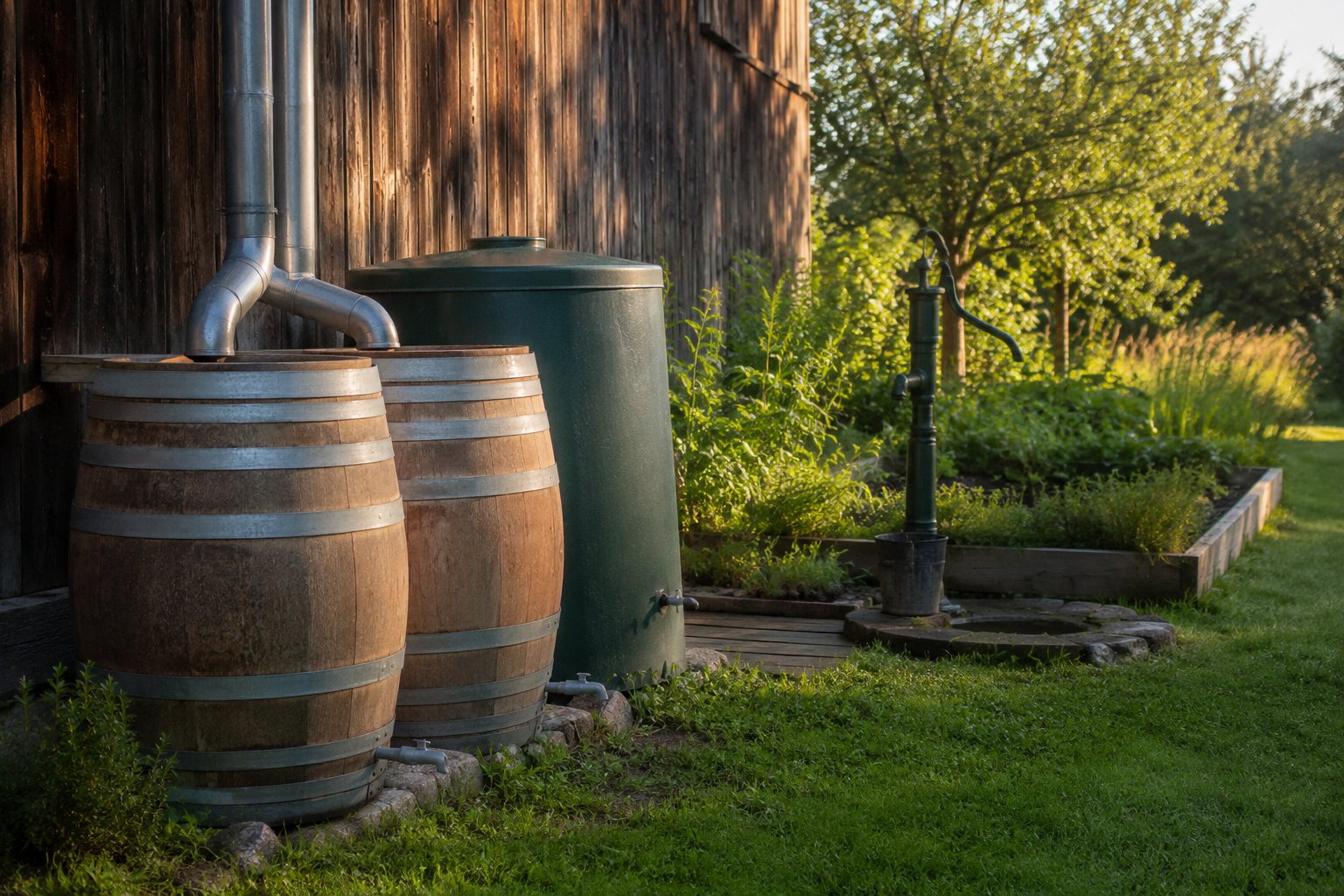
Womit ihr anfangt, die erste WerkzeugkisteWhat to start with, your first tool kitWhat to start with, your first tool kit

Werbung. Die Produktlinks in diesem Abschnitt sind Partnerlinks zu Amazon. Kaufst du darüber, bekommt diese Seite eine kleine Provision, für dich bleibt der Preis gleich. Als Amazon-Partner verdiene ich an qualifizierten Verkäufen. Verlinkt ist jeweils ein Gerät, mit dem man gut arbeiten kann, keine Kaufempfehlung im Sinne eines Tests. Die aktuellen Preise stehen bei Amazon, die Spannen hier sind eigene Schätzungen. Falls ein Modell ausläuft, führt der Zusatzlink zu vergleichbaren Geräten.

Advertising. The product links in this section are affiliate links to Amazon. If you buy through them, this site gets a small commission, and the price stays the same for you. As an Amazon Associate I earn from qualifying purchases. What is linked is a tool you can work with well, not a buying recommendation in the sense of a test. The current prices are at Amazon, and the ranges here are estimates of my own. If a model is discontinued, the extra link leads to comparable tools.

Zuerst, rund 300 EuroStart here, around 300 euros

Akkuschrauber 18 Volt mit zwei Akkus und einem Satz Bits80 bis 110 Euro, gebraucht in 28 von 61 Anleitungen
Cordless drill driver, 18 volt, with two batteries and a set of bits80 to 110 euros, used in 28 of 61 guides
Bei Amazon:At Amazon: Bosch EasyDrill 18V-40, 2 Akkus · Bosch Bit-Satz, 43 Teile · weitere Modellemore models
Wasserwaage 60 cm und 120 cm25 Euro, gebraucht in 39 von 61 Anleitungen
Spirit levels of 60 cm and 120 cm25 euros, used in 39 of 61 guides
Bei Amazon:At Amazon: Stabila 60 cm, Type 80 AS-2 · Stabila 120 cm, Type 70 · weitere Modellemore models
Spaten und Schaufel40 Euro, gebraucht in 28 von 61 Anleitungen
Spade and shovel40 euros, used in 28 of 61 guides
Bei Amazon:At Amazon: Fiskars Gartenspaten, spitz · Fiskars Schaufel, 23,5 cm · weitere Modellemore models
Schubkarre 100 Liter mit Luftrad55 Euro, gebraucht in 22 von 61 Anleitungen
Wheelbarrow, 100 litres, with a pneumatic wheel55 euros, used in 22 of 61 guides
Bei Amazon:At Amazon: Schubkarre 100 l, 250 kg · weitere Modellemore models
Zollstock und Maßband 30 m15 Euro, gebraucht in 18 von 61 Anleitungen
Folding rule and a 30 m tape measure15 euros, used in 18 of 61 guides
Bei Amazon:At Amazon: Stanley Gliedermaßstab, 2 m · Rollbandmaß 30 m, Glasfaser · weitere Modellemore models
Maurerschnur 50 m mit Holzpflöcken10 Euro, gebraucht in 15 von 61 Anleitungen
Builders line, 50 m, with wooden pegs10 euros, used in 15 of 61 guides
Bei Amazon:At Amazon: Maurerschnur 50 m · Holzpflöcke, 15 Stück, 40 cm · weitere Modellemore models
Handsäge, dazu Arbeitshandschuhe und Schutzbrille40 Euro, gebraucht in 16 von 61 Anleitungen
Hand saw, plus work gloves and safety glasses40 euros, used in 16 of 61 guides
Bei Amazon:At Amazon: Bahco Handsäge Superior · Leder-Arbeitshandschuhe, 4 Paar · Uvex Schutzbrille i-Works · weitere Modellemore models

Wenn ihr weitermacht, rund 800 EuroIf you carry on, around 800 euros

Handkreissäge mit Führungsschiene150 bis 200 Euro, gebraucht in 14 von 61 Anleitungen
Circular saw with a guide rail150 to 200 euros, used in 14 of 61 guides
Bei Amazon:At Amazon: Bosch GKS 190 · Bosch Führungsschiene FSN RA · weitere Modellemore models
Bohrhammer mit Steinbohrern von 6 bis 12 mm100 bis 110 Euro, gebraucht in 15 von 61 Anleitungen
Rotary hammer with masonry bits from 6 to 12 mm100 to 110 euros, used in 15 of 61 guides
Bei Amazon:At Amazon: Bosch GBH 2-21, SDS plus · SDS-plus Bohrer-Satz, 5 bis 12 mm · weitere Modellemore models
Stichsäge mit Blättern für Holz60 bis 70 Euro, gebraucht in 7 von 61 Anleitungen
Jigsaw with blades for wood60 to 70 euros, used in 7 of 61 guides
Bei Amazon:At Amazon: Bosch PST 650 · Stichsägeblätter für Holz, Satz · weitere Modellemore models
Vorschlaghammer 5 kg und Fäustel 1 kg40 bis 45 Euro, gebraucht in 10 von 61 Anleitungen
Sledgehammer of 5 kg and a club hammer of 1 kg40 to 45 euros, used in 10 of 61 guides
Bei Amazon:At Amazon: Vorschlaghammer, Fiberglasstiel · Fäustel 1 kg, Fiberglasstiel · weitere Modellemore models
Wasserwaage 200 cm40 bis 45 Euro, gebraucht in 10 von 61 Anleitungen
Spirit level, 200 cm40 to 45 euros, used in 10 of 61 guides
Bei Amazon:At Amazon: Wasserwaage 200 cm, Alu · weitere Modellemore models
Ratschenkasten mit Nüssen 8 bis 22 mm und zwei Rohrzangen90 bis 100 Euro, gebraucht in 12 von 61 Anleitungen
Ratchet set with sockets from 8 to 22 mm and two pipe wrenches90 to 100 euros, used in 12 of 61 guides
Bei Amazon:At Amazon: KS Tools Steckschlüsselsatz · Wasserpumpenzangen, Satz · weitere Modellemore models
Kappsäge und vier Schraubzwingen180 bis 200 Euro, gebraucht in 5 von 61 Anleitungen
Mitre saw and four clamps180 to 200 euros, used in 5 of 61 guides
Bei Amazon:At Amazon: Einhell Zug-Kapp-Gehrungssäge · Schraubzwingen, 4 Stück · weitere Modellemore models

Besser leihen als kaufenBetter hired than bought

Diese Geräte stehen bewusst ohne Kauflink. Ihr braucht sie an ein oder zwei Tagen, und Leihen kostet einen Bruchteil. Baumarkt, Maschinenring oder der Nachbar mit Hof.These machines are deliberately listed without a link to buy. You need them on one or two days, and hiring costs a fraction of the price. Ask at the DIY store, at the Maschinenring (a regional co-operative that shares farm machinery) or at the neighbour with a farmyard.

RüttelplatteKommt in sieben Anleitungen vor, kostet etwa 45 Euro am Tag, wiegt 60 bis 100 Kilo und passt in keinen Kofferraum.
Plate compactorIt turns up in seven guides, costs about 45 euros a day, weighs 60 to 100 kilos and fits in no car boot.
Minibagger 5 Tonnen mit Anhänger200 bis 350 Euro am Tag plus Transport, ihr braucht ihn an zwei Tagen im Jahr, und Abstellplatz und Wartung hat niemand.
Mini excavator of 5 tonnes with a trailer200 to 350 euros a day plus transport. You need it on two days in the year, and nobody has the space to park it or the time to service it.
Betonmischer 140 Liter40 bis 60 Euro am Tag, danach steht er zwei Jahre in der Ecke und rostet fest.
Concrete mixer, 140 litres40 to 60 euros a day, and after that it stands in the corner for two years and rusts solid.
Rotationslaser mit Empfänger25 bis 40 Euro am Tag statt ab 400 Euro Kauf, gebraucht wird er nur beim Abstecken großer Flächen.
Rotating laser with a receiver25 to 40 euros a day instead of 400 euros and up to buy, and it is only wanted when you set out a large area.
Gerüst mit AuffanggurtWird mit Aufbauplan geliefert, lagert im eigenen Bestand schlecht und ist ohne Einweisung gefährlich.
Scaffolding with a safety harnessIt comes with an assembly plan, it stores badly in your own shed, and without instruction it is dangerous.
Motorsäge mit Schnittschutzhose und HelmHolt euch lieber jemanden mit Motorsägenschein, die Schutzausrüstung allein kostet 300 Euro und die Übung fehlt trotzdem.
Chainsaw with cut-protection trousers and helmetBetter to fetch somebody who holds a Motorsägenschein (the German chainsaw certificate). The protective kit alone costs 300 euros, and the practice is still missing.
Kernbohrer 150 bis 160 mm50 bis 80 Euro am Tag, für zwei Löcher im ganzen Leben lohnt der Kauf nie.
Core drill, 150 to 160 mm50 to 80 euros a day, and for two holes in a whole lifetime buying never pays.
Anhänger 750 kg20 bis 40 Euro am Tag im Baumarkt, denn eine Tonne Schotter oder eine Baustahlmatte von 5 Metern geht in keinen Pkw.
Trailer, 750 kg20 to 40 euros a day at the DIY store, because a tonne of crushed stone or a steel reinforcing mesh of 5 metres goes in no car.

Bitte lies das einmal.Please read this once. Diese Anleitungen sind nach bestem Wissen zusammengetragen und ersetzen weder eine Planung noch eine Fachfirma. Bauordnung, Wasserrecht und Naturschutz sind in jedem Bundesland und oft in jeder Gemeinde anders geregelt, und sie ändern sich. Frag vor dem ersten Spatenstich bei deiner Bauaufsicht, deiner unteren Wasserbehörde oder deinem Bezirksschornsteinfeger nach, was bei dir gilt. AllesAll, was mit Statik, Feuer, Strom oder Trinkwasser zu tun hat, gehört in die Hände von Menschen, die dafür ausgebildet sind. Wir übernehmen keine Haftung für Schäden, die beim Nachbauen entstehen.These guides have been put together to the best of our knowledge, and they replace neither proper planning nor a specialist firm. Building law, water law and nature protection are regulated differently in every federal state and often in every municipality, and they change. Before the first spade goes into the ground, ask your Bauaufsicht (the local building control office), your untere Wasserbehörde (the lower water authority of your district) or your Bezirksschornsteinfeger (the district chimney sweep) what applies where you live. Everything to do with structure, fire, electricity or drinking water belongs in the hands of people who are trained for it. We accept no liability for damage that arises when you build these projects.

Please read this once. These guides have been put together to the best of our knowledge, and they replace neither proper planning nor a specialist firm. Building law, water law and nature protection are regulated differently in every federal state and often in every municipality, and they change. Before the first spade goes into the ground, ask your Bauaufsicht (the local building control office), your untere Wasserbehörde (the lower water authority of your district) or your Bezirksschornsteinfeger (the district chimney sweep) what applies where you live. Everything to do with structure, fire, electricity or drinking water belongs in the hands of people who are trained for it. We accept no liability for damage that arises when you build these projects.