Liebe ist die LösungLove is the solution
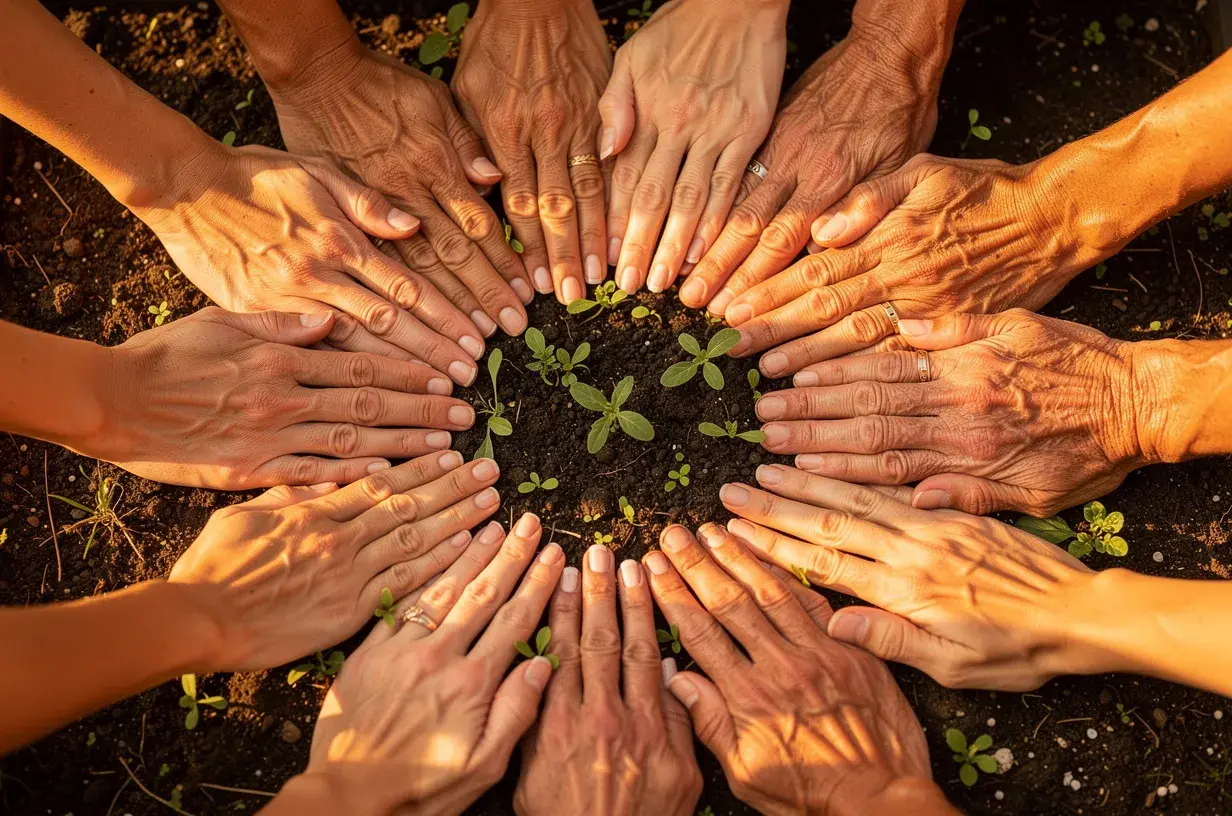
Man kann die Krisen der Welt einzeln bekämpfen, ein Leben lang. Oder man schaut auf ihre gemeinsame Wurzel. Fast alles, was schiefläuft, entspringt derselben Quelle: Trennung. Und fast alles heilt an derselben: Liebe und Einheit.You can fight the world's crises one by one, for a lifetime. Or you can look at their common root. Almost everything that goes wrong springs from the same source: separation. And almost everything heals at the same one: love and unity.
Hunger, Krieg, Ausbeutung, Einsamkeit, die Zerstörung der Natur. So verschieden diese Probleme aussehen, sie haben zwei Wurzeln gemeinsam: das Gefühl, getrennt voneinander zu sein, und das kurzfristige Denken, das nur bis zum eigenen Vorteil reicht. Wer sich getrennt fühlt, nimmt sich, was er kriegen kann. Wer sich verbunden fühlt, gibt, weil er weiß, dass er Teil eines Ganzen ist. Die neue Welt entsteht nicht dadurch, dass wir tausend Symptome bekämpfen, sondern dadurch, dass wir die eine Wurzel nähren.Hunger, war, exploitation, loneliness, the destruction of nature. As different as these problems look, they share two roots: the feeling of being separate from one another, and the short-term thinking that reaches no further than one's own advantage. Whoever feels separate takes whatever they can get. Whoever feels connected gives, because they know they are part of a whole. The new world does not arise from fighting a thousand symptoms, but from nourishing the one root.
„Die Liebe ist der Universalschlüssel zu allem.""Love is the universal key to everything."
Was Ami uns zeigtWhat Ami shows us
In dem Buch „Ami, der Junge von den Sternen" von Enrique Barrios besucht ein Junge von einem fernen, friedlichen Planeten die Erde. Seine wichtigste Botschaft ist verblüffend einfach: Das Grundgesetz des Universums ist die Liebe. Und der Entwicklungsstand einer Welt bemisst sich nicht an ihrer Technik, sondern an ihrem Grad an Liebe.In the book "Ami, Child of the Stars" by Enrique Barrios, a boy from a distant, peaceful planet visits the Earth. His most important message is astonishingly simple: the fundamental law of the universe is love. And a world's level of development is measured not by its technology, but by its degree of love.
Denn Technik ohne Liebe wird gefährlich: Dieselbe Kraft, die heilen kann, kann auch zerstören. Erst wenn eine Welt genug Liebe entwickelt, wird ihr Wissen zum Segen statt zur Bedrohung, und aus dem Planeten kann ein Paradies werden. Genau da stehen wir: Wir haben die Technik längst. Was noch wachsen darf, ist die Liebe, die ihr die Richtung gibt. Das ist keine ferne Fantasie, sondern die Kernaufgabe unserer Zeit.For technology without love becomes dangerous: the same force that can heal can also destroy. Only when a world develops enough love does its knowledge become a blessing instead of a threat, and the planet can become a paradise. That is exactly where we stand: we have long had the technology. What may still grow is the love that gives it direction. This is no distant fantasy, but the core task of our time.
Und das ist keine reine Fantasie: Schon heute gibt es Länder und Städte, die eine Welt nicht mehr am Bruttoinlandsprodukt messen, sondern am Wohl der Menschen und der Erde. Was das konkret bedeutet, zeigt die Seite Woran man eine Welt misst.And this is not mere fantasy: even today there are countries and cities that no longer measure a world by its gross domestic product, but by the wellbeing of people and the Earth. What that means in practice is shown on the page How to measure a world.
Mehr über Ami und was er unserer Welt heute raten würde, liest du auf der Seite Ami, der Junge von den Sternen. Das Hörbuch findest du im Archiv der Bücher.More about Ami and what he would advise our world today is on the page Ami, Child of the Stars. The audiobook is in the archive of books.
Die Liebe als deine SuperkraftLove as your superpower
In seinen Büchern „Liebe ist meine Superkraft" und „Die Magie des Lebens" beschreibt Markus die Liebe nicht als weiches Gefühl, sondern als die mächtigste Kraft, die wir haben. Sinngemäß sagt er: Dein wahrer Wesenskern besteht aus reiner, bedingungsloser Liebe, und diese ist hochansteckend, sobald wir sie zum Ausdruck bringen. Oft ist sie nur unter Schichten von altem Schmerz verdeckt, doch sie ist nie verloren.In his books "Love is My Superpower" and "The Magic of Life", Markus describes love not as a soft feeling, but as the most powerful force we have. In essence he says: your true core is made of pure, unconditional love, and it is highly contagious the moment we express it. Often it is only hidden beneath layers of old pain, but it is never lost.
Das Schöne daran: Du musst nicht die ganze Welt verändern. Es genügt, dass du dich selbst mehr der Liebe zuwendest. Denn deine eigene Verwandlung verändert dein Umfeld, dieses wieder seines, und so weiter. Wenige Menschen, die die Liebe vorleben, können unzählige andere daran erinnern, exponentiell. Wenn ein einzelner Mensch schon so viel bewirkt, was können dann viele, überall verteilt auf diesem Planeten?The beauty of it: you do not have to change the whole world. It is enough that you turn more toward love yourself. Because your own transformation changes those around you, and theirs in turn, and so on. A few people who live love by example can remind countless others of it, exponentially. If a single person can already do so much, what could many, spread all over this planet, do?
Und Liebe meint hier weit mehr als das Gefühl zwischen einem Paar. Sie ist bedingungslos, sie ist Akzeptanz. Sie zeigt sich immer dann, wenn wir aufhören, gegen das zu kämpfen, was gerade ist, und es stattdessen wertschätzen. Etwas zu lieben heißt fast, es schön zu finden. Wo diese Liebe fehlt, wachsen Angst, Hass und Leid, ganz nach dem Grundsatz wie innen, so außen. Darum beginnt jede Heilung der Welt in uns selbst.And love here means far more than the feeling between a couple. It is unconditional, it is acceptance. It shows itself whenever we stop fighting what is and appreciate it instead. To love something is almost to find it beautiful. Where this love is missing, fear, hate and suffering grow, following the principle as within, so without. That is why every healing of the world begins within us.
Diese Gedanken sind in eigenen Worten aus Markus' Büchern zusammengetragen. Nimm sie wie ein Buffet: das Nährende mit, den Rest lass liegen. Die Bücher findest du im Archiv der Bücher.These thoughts are gathered in our own words from Markus' books. Take them like a buffet: keep what nourishes, leave the rest. The books are in the archive of books.
Von Fehlern zu LösungenFrom mistakes to solutions
Jeder verbreitete Denkfehler hat ein liebevolleres Gegenstück. Nicht als Vorwurf, sondern als Einladung.Every widespread error in thinking has a more loving counterpart. Not as a reproach, but as an invitation.
Statt kurzfristigem DenkenInstead of short-term thinking
Der geliehene PlanetThe borrowed planet
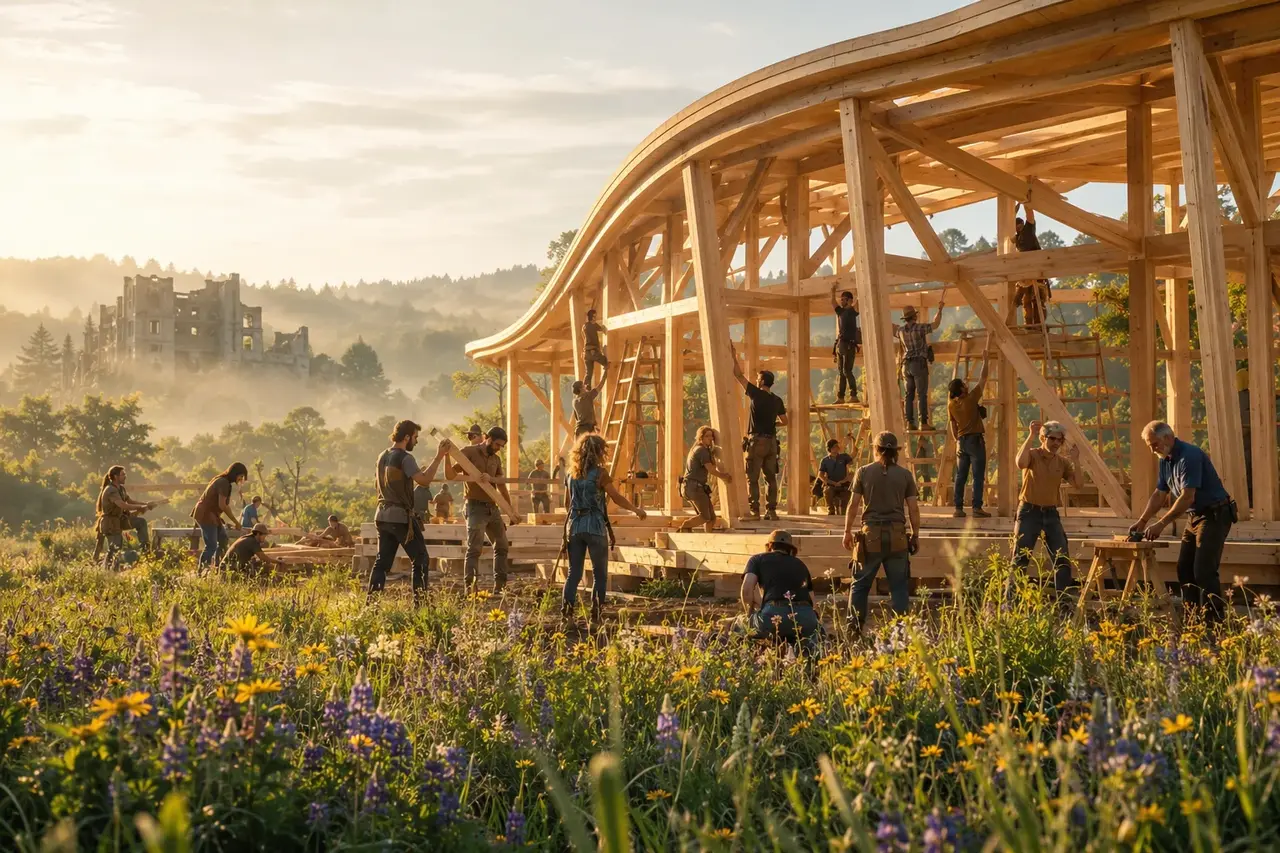
Kurzfristiges Denken plündert die Erde für den Gewinn von heute. Doch wir haben sie nicht von unseren Vorfahren geerbt, wir haben sie uns von unseren Enkeln und Urenkeln geliehen. Wer so entscheidet, als säßen die kommenden Generationen mit am Tisch, handelt fast von selbst weiser.Short-term thinking plunders the earth for today's profit. But we did not inherit it from our ancestors, we borrowed it from our grandchildren and great-grandchildren. Whoever decides as if the coming generations were sitting at the table acts more wisely almost by itself.
Statt TrennungInstead of separation
EinheitUnity
Wir sind wie Tropfen, die glauben, allein zu sein, und dabei denselben Ozean bilden. Was ich dem anderen antue, tue ich einem Teil von mir an. Aus diesem einen Perspektivwechsel wächst fast jede gute Tat von selbst.We are like drops that believe they are alone, while together forming the same ocean. What I do to another, I do to a part of myself. From this single shift of perspective almost every good deed grows on its own.
Statt AngstInstead of fear
LiebeLove
In uns leben zwei Wölfe, die Angst und die Liebe. Welcher stark wird, hängt davon ab, welchen wir füttern. Vor jeder Entscheidung dürfen wir fragen: Nährt das die Angst oder die Liebe? Und dann den weißen Wolf wählen.Within us live two wolves, fear and love. Which grows strong depends on which we feed. Before every decision we may ask: does this feed fear or love? And then choose the white wolf.
Statt KonkurrenzInstead of competition
ZusammenarbeitCooperation
Ein Bauer gewinnt einen Preis für seinen Mais und teilt sein bestes Saatgut mit den Nachbarn. Warum? Weil der Wind die Pollen trägt. Nur wenn auch die Nachbarn guten Mais anbauen, bleibt seiner gut. Im Miteinander gewinnen am Ende alle mehr als im Gegeneinander.A farmer wins a prize for his corn and shares his best seed with his neighbours. Why? Because the wind carries the pollen. Only if the neighbours grow good corn too does his stay good. Together, in the end, everyone gains more than against one another.
Statt AnhäufenInstead of hoarding
GebenGiving
Wer nur festhält, lebt in ständiger Sorge, es könnte nicht reichen. Doch je mehr wir aus Freude geben, desto mehr Fülle entsteht für alle, wie bei den langen Löffeln, mit denen sich die Menschen im Himmel gegenseitig füttern.Whoever only holds on lives in constant worry that it might not be enough. Yet the more we give out of joy, the more abundance arises for everyone, like the long spoons with which people in heaven feed one another.
Statt BekämpfenInstead of fighting
ErschaffenCreating
Wir müssen das Alte nicht stürzen. Wir bauen etwas Neues, das schöner und lebendiger ist, und das Alte wird von selbst überflüssig. Wärme erreicht, was Gewalt nur fester verschließt.We do not have to topple the old. We build something new that is more beautiful and alive, and the old becomes obsolete on its own. Warmth achieves what force only closes tighter.
Statt WiderstandInstead of resistance
AnnehmenAccepting
Was wir bekämpfen, wächst durch unseren Widerstand. Nehmen wir zuerst an, was gerade ist, verliert es seine Macht über uns, und wir gewinnen die Ruhe zurück, es sanft zu verändern.What we fight grows through our resistance. If we first accept what is, it loses its power over us, and we regain the calm to change it gently.
Statt VerurteilenInstead of condemning
VerstehenUnderstanding
Ein Urteil trennt in Sekunden. Eine Frage verbindet: Warum hat dieser Mensch so gehandelt? Hinter fast jedem Verhalten steht eine Not, die wir erst sehen, wenn wir hinschauen statt abzustempeln.A judgement separates in seconds. A question connects: why did this person act this way? Behind almost every behaviour is a need we only see when we look instead of labelling.
Statt JammernInstead of complaining
DankbarkeitGratitude
Das Klagen sucht das Fehlende und findet immer mehr davon. Die Dankbarkeit sucht das Vorhandene und lässt es wachsen. Beide haben recht, doch nur eine macht das Herz weit.Complaining looks for what is missing and finds ever more of it. Gratitude looks for what is there and lets it grow. Both are right, yet only one opens the heart.
Statt MangeldenkenInstead of scarcity thinking
FülleAbundance
Wer aus dem Mangel lebt, hält fest und misstraut. Wer die Fülle sieht, die längst da ist, teilt leichter, und gerade dadurch wird sie größer. Es ist genug für alle da, wir müssen es nur einander reichen.Whoever lives from scarcity holds on and distrusts. Whoever sees the abundance that is already here shares more easily, and that is exactly what makes it grow. There is enough for everyone, we only have to pass it to one another.
Statt GrollInstead of resentment
VergebungForgiveness
Groll trägt man wie glühende Kohlen, in der Hoffnung, den anderen zu treffen, und verbrennt sich dabei die eigene Hand. Vergebung löscht das Feuer, vor allem im eigenen Herzen.Resentment is carried like glowing coals, in the hope of hurting the other, and burns your own hand. Forgiveness puts out the fire, above all in your own heart.
Statt VergleichenInstead of comparing
WertschätzenAppreciating
Der Vergleich raubt jede Freude, es gibt immer jemanden, der mehr hat. Die Wertschätzung schaut auf das eigene Leben und entdeckt, wie reich es längst ist.Comparison robs every joy, there is always someone who has more. Appreciation looks at your own life and discovers how rich it already is.
Statt Tugenden erzwingenInstead of forcing virtues
Die Früchte der LiebeThe fruits of love
Geduld, Vergebung, Großzügigkeit, Urteilsfreiheit. Man kann sie einzeln erkämpfen, ein Leben lang. Oder man nährt die eine Wurzel, die Liebe, und sie reifen von ganz allein, als ihre Früchte.Patience, forgiveness, generosity, freedom from judgement. You can struggle for each one, a whole life long. Or you nourish the one root, love, and they ripen all by themselves, as its fruits.
Erst die Wurzel, dann die FruchtFirst the root, then the fruit
Unter all diesen Paaren liegt eine noch tiefere Verwechslung, vielleicht die größte von allen: Wir halten die Wirkung für die Ursache. Wir sehen eine reife Frucht und versuchen, sie nachzubauen, statt den Boden zu schaffen, auf dem sie ganz von selbst wächst. Fast jedes menschliche Problem ist im Kern eine solche Verwechslung von Ursache und Wirkung.Beneath all these pairs lies an even deeper confusion, perhaps the greatest of all: we mistake the effect for the cause. We see a ripe fruit and try to rebuild it, instead of creating the ground on which it grows all by itself. Almost every human problem is, at its core, such a confusion of cause and effect.
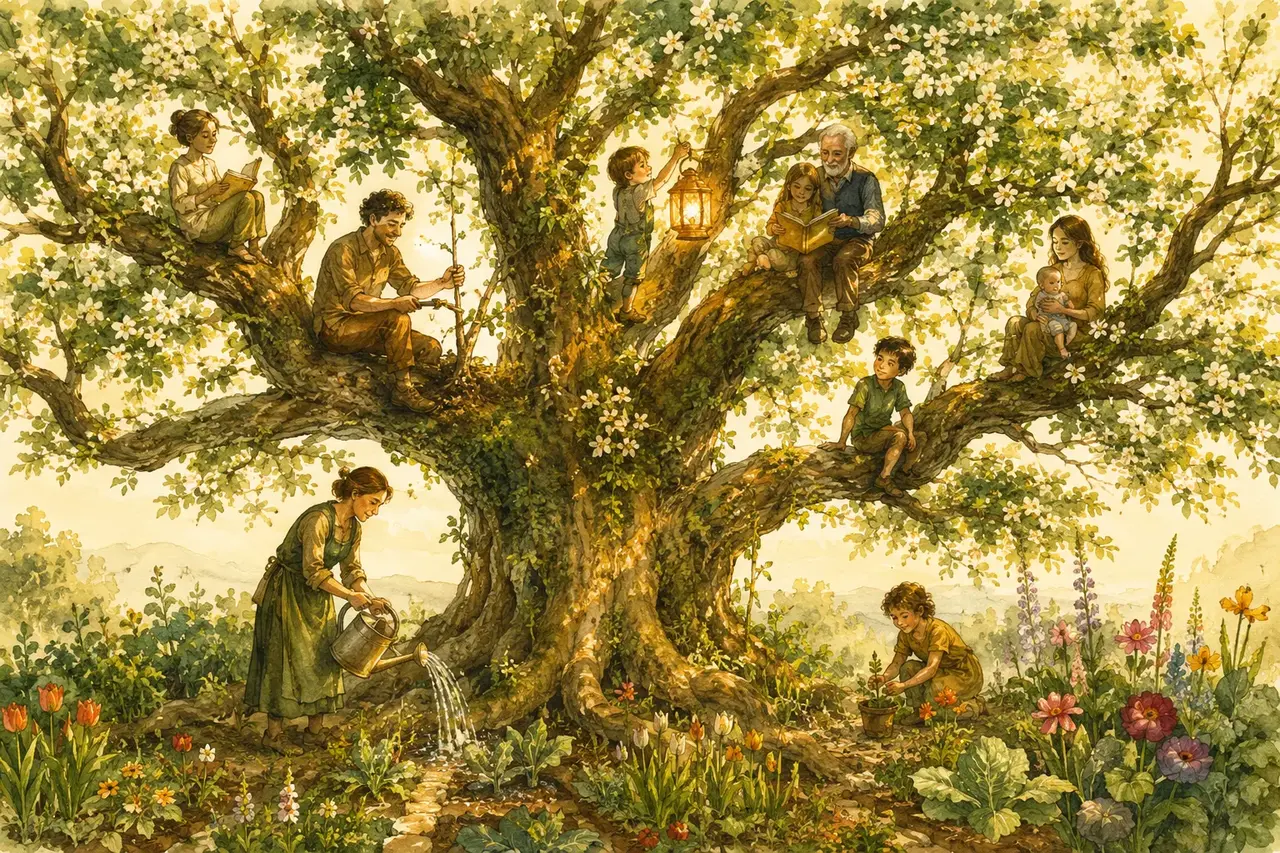
Niemand klebt Äpfel an einen kahlen Baum und wundert sich, warum sie herunterfallen. Wir kümmern uns um die Wurzeln, die Erde, das Wasser und das Licht, und die Früchte entstehen von selbst. Mit uns selbst aber machen wir es umgekehrt. Sei urteilsfrei. Sei widerstandslos. Sei diszipliniert. Sei dankbar. Sei liebevoll. Das sind alles Äpfel. Die eigentliche Frage ist: Auf welchem Baum wachsen sie?No one glues apples onto a bare tree and then wonders why they fall off. We tend the roots, the soil, the water and the light, and the fruit comes on its own. Yet with ourselves we do the opposite. Be free of judgement. Be free of resistance. Be disciplined. Be grateful. Be loving. These are all apples. The real question is: on which tree do they grow?
„Vielleicht ist Liebe nicht eine weitere Frucht des Lebens, sondern der Baum selbst.""Perhaps love is not another fruit of life, but the tree itself."
Ein Kind hört Musik und beginnt zu tanzen. Es denkt nicht darüber nach, wie es den rechten Fuß bewegen muss. Der Tanz ist die Folge seiner Freude. Ein Erwachsener beobachtet das Kind und schreibt ein Buch darüber: Hebe den rechten Fuß, bewege den linken Arm, lächle jetzt, dreh dich einmal im Kreis. Am Ende bewegt er seinen Körper vielleicht genauso, und doch tanzen die beiden nicht aus derselben Quelle. Der eine tanzt aus Freude. Der andere ahmt die Bewegungen der Freude nach.A child hears music and begins to dance. It does not think about how to move its right foot. The dance is the consequence of its joy. An adult watches the child and writes a book about it: lift the right foot, move the left arm, smile now, turn once around. In the end he may move his body just the same, and yet the two do not dance from the same source. One dances from joy. The other imitates the movements of joy.
Auch im Großen sehen wir das überall. Der glückliche Mensch hilft anderen, also zwingen sich Millionen zur Hilfsbereitschaft. Der weise Mensch urteilt nicht, also mühen sich Millionen, nicht mehr zu urteilen. Der erfolgreiche Mensch steht früh auf, also kopieren Millionen seine Morgenroutine. Immer sehen wir nur die Früchte und nie den Garten. Deshalb wirken so viele Ratgeber nur kurz: Sie arbeiten auf der Ebene der Früchte, nicht auf der der Wurzel.On the large scale we see it everywhere too. The happy person helps others, so millions force themselves to be helpful. The wise person does not judge, so millions strain not to judge any more. The successful person rises early, so millions copy his morning routine. We always see only the fruits and never the garden. This is why so many guides work only briefly: they operate on the level of the fruits, not of the root.
Vielleicht liegt es daran, dass wir die Waggons vor die Lokomotive stellen und uns wundern, warum nichts fährt. Ich werde glücklich sein, wenn. Ich werde lieben, wenn. Ich werde das Leben genießen, wenn erst die Welt schön ist. So wartet ein Mensch sein ganzes Leben darauf, dass die Wirkung endlich die Ursache hervorbringt. Doch die Lokomotive gehört nach vorn. Lerne zuerst, Liebe und Freude zu empfinden, und die Waggons folgen ganz von allein.Perhaps it is because we put the wagons in front of the engine and wonder why nothing moves. I will be happy when. I will love when. I will enjoy life once the world is beautiful. So a person waits a whole lifetime for the effect to finally produce the cause. But the engine belongs at the front. First learn to feel love and joy, and the wagons follow all by themselves.
Damit ändern sich sogar die Fragen, die wir uns stellen. Nicht mehr: Wie zwinge ich mich zu mehr Disziplin, sondern: In welchem Zustand wird Disziplin auf einmal leicht? Nicht mehr: Wie höre ich auf zu urteilen, sondern: In welchem Zustand verschwindet das Bedürfnis zu urteilen ganz von selbst? Nicht mehr: Wie zwinge ich mich zu meditieren, sondern: Wie komme ich erst in ein Wohlbefinden, aus dem heraus die Stille von allein entsteht?This even changes the questions we ask ourselves. No longer: how do I force myself into more discipline, but: in which state does discipline suddenly become easy? No longer: how do I stop judging, but: in which state does the need to judge vanish on its own? No longer: how do I force myself to meditate, but: how do I first arrive at a wellbeing out of which stillness arises by itself?
Die Raupe versucht nicht, schöner zu fliegen. Sie verwandelt sich, und der Flug ist nur die sichtbare Folge. Vielleicht mühen wir uns ein Leben lang, schöner zu fliegen, geduldiger, liebevoller, ein besserer Mensch zu werden, und übersehen dabei, dass all das nur die Flügel sind. Die eigentliche Arbeit geschieht im Kokon.The caterpillar does not try to fly more beautifully. It transforms, and the flight is only the visible consequence. Perhaps we labour a lifetime to fly more beautifully, to be more patient, more loving, a better person, and overlook that all of this is only the wings. The real work happens in the cocoon.
„Die meisten verändern ihr Leben von außen nach innen. Die Liebeslösung beginnt von innen nach außen. Sie fragt nicht zuerst: Was soll ich tun? Sondern: Wer bin ich, wenn Liebe mein natürlicher Zustand ist?""Most people change their life from the outside in. The love solution begins from the inside out. It does not first ask: what should I do? But: who am I when love is my natural state?"
Dann ist die Liebe nicht die Belohnung eines gelungenen Lebens, sondern sein Ausgangspunkt. Und das Paradies beginnt nicht damit, dass die Welt schön wird, sondern damit, dass wir sie schon jetzt mit anderen Augen betrachten. Denn wer nur die Früchte sucht, wird lange suchen. Wer die Wurzel nährt, wird überrascht sein, was ganz von selbst zu wachsen beginnt.Then love is not the reward of a life well lived, but its starting point. And paradise does not begin with the world becoming beautiful, but with us seeing it, already now, through different eyes. For whoever only seeks the fruits will search for a long time. Whoever nourishes the root will be amazed at what begins to grow all by itself.
Wie dieser innere Boden aussieht, aus dem alles wächst, vertieft die Seite Das Bewusstsein einer neuen Welt.What this inner ground looks like, the one from which everything grows, is explored on the page The consciousness of a new world.
Die Türen in die LiebeThe doorways into love
Wie also nährt man die Wurzel? Vier Haltungen führen fast von selbst in den liebenden Seinszustand. Sie bilden den Kern von Markus' Buch „Tantra jenseits von Sex", wo Tantra die weite Kunst meint, ganz da und ganz heil zu sein, weit über den Körper hinaus.So how does one nourish the root? Four attitudes lead almost by themselves into the loving state of being. They form the heart of Markus' book "Tantra beyond sex", where tantra means the wide art of being fully present and fully whole, far beyond the body.
PräsenzPresence
Liebe lebt nur im Jetzt. Wer ganz gegenwärtig ist, mit allen Sinnen im Hier, hört auf zu bewerten und zu vergleichen und findet sich mitten in der Liebe wieder. Ganz praktisch: den Tee wirklich schmecken, dem anderen wirklich zuhören, den Weg wirklich gehen.Love lives only in the now. Whoever is fully present, with all senses in the here, stops judging and comparing and finds themselves in the middle of love. Quite practically: really taste the tea, really listen to the other, really walk the path.
AnnahmeAcceptance
Solange wir gegen das kämpfen, was ist, bleiben wir getrennt, von der Welt und von uns selbst. Wer annimmt, was gerade da ist, auch die eigene Unvollkommenheit, schafft erst den Raum, in dem Liebe atmen kann. Angenommen wird nicht schwächer, sondern weich und stark zugleich.As long as we fight what is, we stay separate, from the world and from ourselves. Whoever accepts what is present, including their own imperfection, first creates the space in which love can breathe. What is accepted does not grow weaker, but soft and strong at once.
HingabeSurrender
Nicht als Aufgeben, sondern als Vertrauen. Wer sich dem Leben hingibt, statt es krampfhaft zu kontrollieren, wird von ihm getragen, so wie das Wasser jeden Schwimmer trägt, sobald er aufhört, dagegen zu strampeln. In der Hingabe geschieht das Leben nicht gegen uns, sondern mit uns.Not as giving up, but as trust. Whoever surrenders to life, instead of clenching to control it, is carried by it, just as water carries every swimmer the moment they stop thrashing against it. In surrender, life does not happen against us, but with us.
GanzheitWholeness
Nichts an uns muss abgespalten oder bekämpft werden. Wenn wir auch unsere Schatten, unsere Angst und unseren Schmerz liebevoll in den Arm nehmen, werden wir ganz. Und aus dieser Ganzheit fließt die Liebe von selbst nach außen, weil sie innen nicht mehr geteilt ist.Nothing in us needs to be split off or fought. When we take even our shadows, our fear and our pain lovingly into our arms, we become whole. And from this wholeness love flows outward by itself, because within it is no longer divided.
Und ganz konkret?And concretely?
Liebe bleibt kein schönes Wort, wenn sie sich in kleine Taten übersetzt. Ein Lächeln an einen Fremden. Ein ehrlich gemeintes Danke. Zuhören, ohne zu urteilen. Das Beste im anderen sehen, bis er selbst daran glaubt. Etwas verschenken, das jemandem heute guttut. Jede dieser Gesten ist ein Tropfen, und viele Tropfen füllen den Ozean.Love stays no pretty word if it translates into small acts. A smile to a stranger. A genuinely meant thank you. Listening without judging. Seeing the best in another until they believe in it themselves. Giving away something that does someone good today. Each of these gestures is a drop, and many drops fill the ocean.